
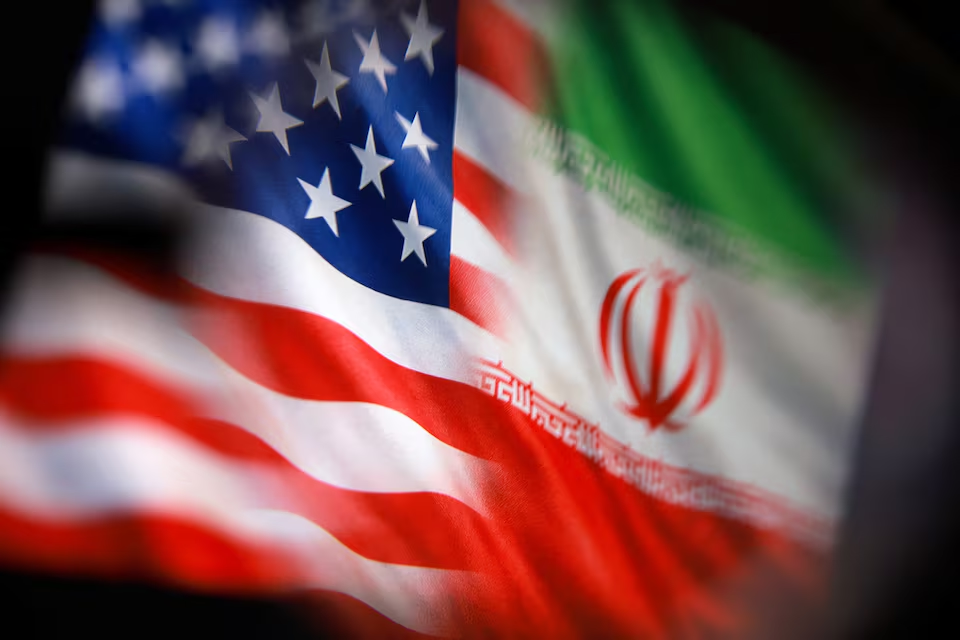
The United States and Iran have reached a comprehensive peace agreement comprising 14 clauses aimed at resolving decades of nuclear tension and regional conflict, according to reports on the accord’s framework.
The deal addresses Iran’s uranium enrichment programme through down-blending commitments, effectively reducing Tehran’s stockpile of weapons-grade material below proliferation thresholds. Crucially, the agreement includes provisions barring Iran from developing or acquiring nuclear weapons, a central demand from Western signatories.
Strategic waterway access forms another pillar of the settlement. The Strait of Hormuz, through which roughly 21 per cent of global oil transits annually, will remain open to international shipping under the accord. Repeated Iranian threats to close the strait during periods of escalation had rattled energy markets and drawn international concern.
For India, developments in the Middle East carry immediate implications for maritime security and energy supplies. The subcontinent imports roughly 80 per cent of its crude oil, with a significant share transiting the Hormuz corridor. Sustained regional tension had elevated energy costs and added risk premiums to Indian shipping in the Gulf of Oman and Arabian Sea.

India’s strategic posture toward Iran has long balanced commercial and geopolitical interests. New Delhi maintains robust defence partnerships with Gulf Cooperation Council states, particularly the UAE and Saudi Arabia, while simultaneously engaging Tehran on issues ranging from the Chabahar Port development to cultural ties rooted in shared historical influence along the Silk Road.
The peace accord also carries indirect implications for Indian Navy operations in the Indian Ocean Region. Reduced regional volatility diminishes the risk of closure of major choke points and allows for more predictable deployment planning for India’s carrier strike groups and escort vessels patrolling sea lanes critical to national commerce.
Energy security remains central to India’s defence calculus. Stable Gulf politics translates into stable crude supplies, which underpins economic growth and defence expenditure capacity. The agreement’s success in de-escalating nuclear tensions removes a variable that had previously influenced geopolitical risk assessments across South Asia and the broader Indo-Pacific.
Implementation and verification mechanisms embedded in the 14 clauses will determine the accord’s durability. International oversight, inspection regimes, and phased sanctions relief tied to compliance benchmarks reflect lessons learned from the 2015 Joint Comprehensive Plan of Action, which collapsed following the US withdrawal in 2018.
India has historically avoided taking sides in US-Iran disputes, instead advocating for dialogue and adherence to international law. New Delhi’s calibrated engagement with both Washington and Tehran reflects its non-aligned tradition while safeguarding critical energy and maritime interests in a region central to India’s Act East and Indo-Pacific strategies.

Facebook Comments