
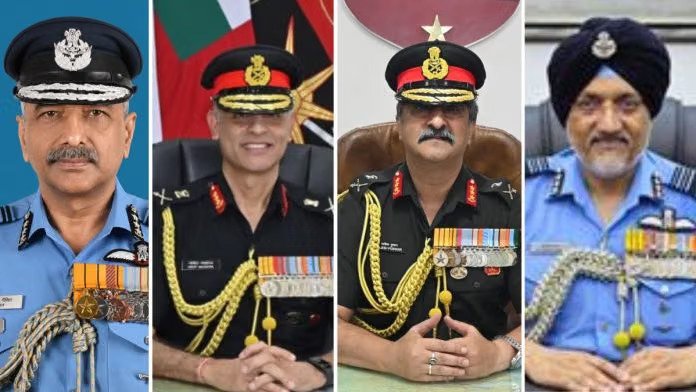
India’s defence establishment has announced a major leadership reshuffle across the three services, with new Vice Chiefs appointed to the Indian Army and Indian Navy, along with postings of senior Army Commanders and a new Chief of Integrated Staff Committee, according to military officials.
The reshuffle reflects the military’s ongoing process of senior command rotation, ensuring continuity in operational readiness and strategic planning across the Indian Armed Forces. Such transitions typically occur as senior officers approach retirement age and their successors are promoted through the rank hierarchy.
The Vice Chief of Army Staff and Vice Chief of Naval Staff positions are among the most critical posts in the Indian military hierarchy. The Vice Chief serves as the principal deputy to the Chief of Staff and assumes command during the Chief’s absence. Given India’s multi-front security environment spanning the Himalayan frontier and the Indian Ocean Region, these appointments carry significant operational weight.
The Chief of Integrated Staff Committee, who also functions as the Principal Staff Officer to the Chairman Chiefs of Staff Committee, oversees tri-service coordination and joint military operations. This role has become increasingly important as India emphasises tri-service integration and theaterisation of commands following the military modernisation drive of the past decade.

Senior Army Commanders heading major regional commands such as Central, Northern, Eastern, Southern, and Southwestern Commands play a direct role in border management, operational preparedness, and counter-insurgency campaigns. Northern Command, responsible for the Line of Control in Jammu and Kashmir and the Line of Actual Control with China, is traditionally considered one of the most strategically sensitive postings.
Leadership transitions in the Indian military are governed by seniority, performance records, and strategic requirements assessed by the Ministry of Defence and the service headquarters. The process ensures that officers with requisite experience in command, operations, and defence policy formulation move into apex positions.
These appointments underscore India’s commitment to institutional continuity while adapting to evolving security challenges. With modernisation programmes across platforms ranging from combat aircraft to naval vessels and land-based missile systems, senior leadership must balance technological integration with operational doctrine and personnel management across a force of over 1.4 million personnel.


Facebook Comments