
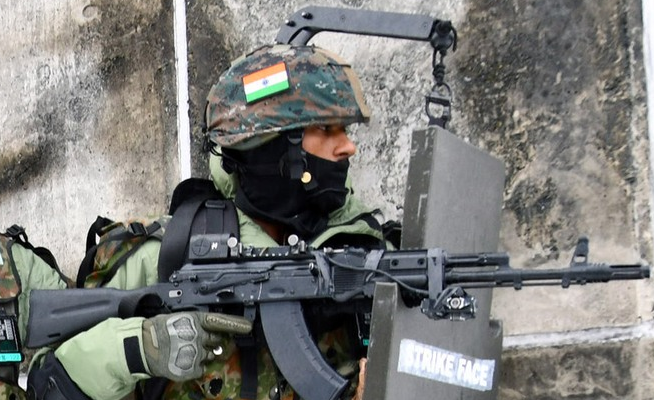
The Indian Army is phasing out the INSAS rifle in favour of the AK-203, marking a significant shift in the service’s small arms strategy after three decades of operational reliance on the indigenously-developed platform, according to military officials.
The transition signals a decisive move toward a proven, battle-tested rifle system. The AK-203, produced under licence by the Ordnance Factories Board at Amethi in Uttar Pradesh, offers superior ergonomics, reliability, and ease of maintenance compared to the INSAS, which entered service in 1986.
The INSAS (Indigenously Developed Small Arm System) was designed by DRDO’s Small Arms Systems Division at Kanpur. While it served the Army capably across varied terrain, from the Kashmir Valley to northeastern operations, the rifle suffered from design constraints inherent to its era. Dust ingestion, lower accuracy under sustained fire, and higher maintenance demands became limiting factors as operational doctrine evolved.
The AK-203 partnership represents a collaboration between Rosoboronexport (Russia’s state arms exporter), Kalashnikov Group, and the Ordnance Factories Board. The rifle is chambered in 7.62x39mm and features modern ergonomics, ambidextrous controls, and a modular platform compatible with contemporary optics and accessories. Its pedigree in global military service across NATO and non-NATO armies provides extensive operational validation.

This procurement decision reflects India’s evolving defence acquisition philosophy. Rather than persist with indigenisation at the expense of battlefield effectiveness, the Army has prioritised operational readiness. The AK-203 licence production at Amethi ensures domestic manufacturing, employment generation, and technology transfer to OFB, preserving the Make in India dimension while deploying a superior platform.
The transition will occur over multiple financial years. INSAS rifles will be gradually withdrawn from frontline units, though reserves may retain them for training and internal security deployments. The manufacturing capacity at Amethi, which has been augmented specifically for AK-203 production, is designed to equip the 1.3-million-strong Indian Army systematically.
Soldiers praise the AK-203’s controllability in rapid-fire scenarios and the robustness of its gas-piston system, which operates reliably in dust-laden and moisture-heavy environments. The rifle’s field-stripping process is faster than the INSAS, reducing maintenance turnaround during operations.
The decision underscores the Army’s operational independence in weapons selection. Even as DRDO continues developing indigenous platforms for future procurement, the service has made clear that proven international systems will be adopted when they deliver measurable advantages to the soldier in the field.




Facebook Comments