
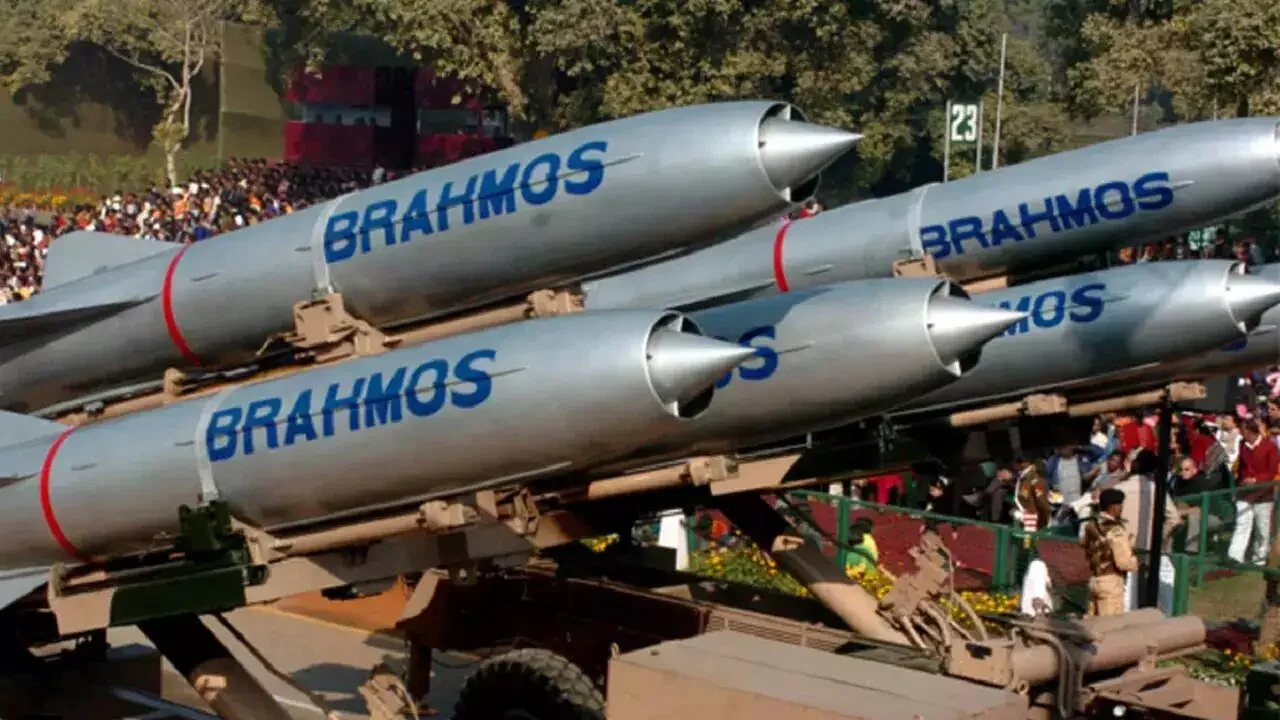
The Defence Research and Development Organisation is developing next-generation variants of the BrahMos cruise missile that will be lighter, possess extended range, and incorporate enhanced stealth characteristics, according to reports on the programme’s advancement.
These upgraded variants represent a significant capability leap for one of India’s most operationally mature indigenous weapon systems. The BrahMos, jointly developed by DRDO and Russia’s NPO Mashinostroyeniya, has become the backbone of India’s precision strike arsenal across the Navy, Army, and Air Force.
The current production variant, BrahMos Block III, already carries a 300-kilogram warhead to ranges exceeding 290 kilometres in its air-launched configuration. Reducing the missile’s weight while extending range improves platform compatibility, particularly for aircraft like the HAL Tejas and naval platforms with weight constraints.
Enhanced stealth features, achieved through refined aerodynamic design and materials technology, would degrade adversary air defence radar detection probability. The existing BrahMos employs a solid-fuelled booster followed by a liquid-fuelled cruise phase, delivering supersonic performance at Mach 2.8 to 3.0 during terminal approach, a characteristic that already complicates interception.


India has conducted operational deployments of BrahMos variants across multiple theatres. The Navy operates the ship-launched variant from Rajput-class and Talwar-class frigates, while the Indian Air Force has integrated the air-launched BrahMos on Su-30MKI fighters since 2018. The Army deployed the land-attack variant, mounted on mobile platforms, during Exercise Gagan Shakti 2018 and subsequent formations along the northern frontier.
The developmental push reflects India’s sustained investment in indigenous missile technology under the Defence Research and Development Organisation’s long-term capability roadmap. Rather than dependence on foreign systems, successive BrahMos variants have been refined through operational feedback and technological advancement in propulsion, guidance, and materials science.
Extended-range, lightweight variants open operational possibilities for smaller naval platforms, unmanned aerial vehicles, and strategic bomber platforms. Stealth enhancements would prove particularly valuable in contested air defence environments, strengthening India’s rapid response and standoff strike posture across the Indian Ocean and forward areas.
The BrahMos programme exemplifies India’s broader push toward self-reliance in defence manufacturing. Since achieving initial operational capability in 2004, successive production batches and platform integration have generated operational experience that now informs next-generation development cycles.




Facebook Comments