
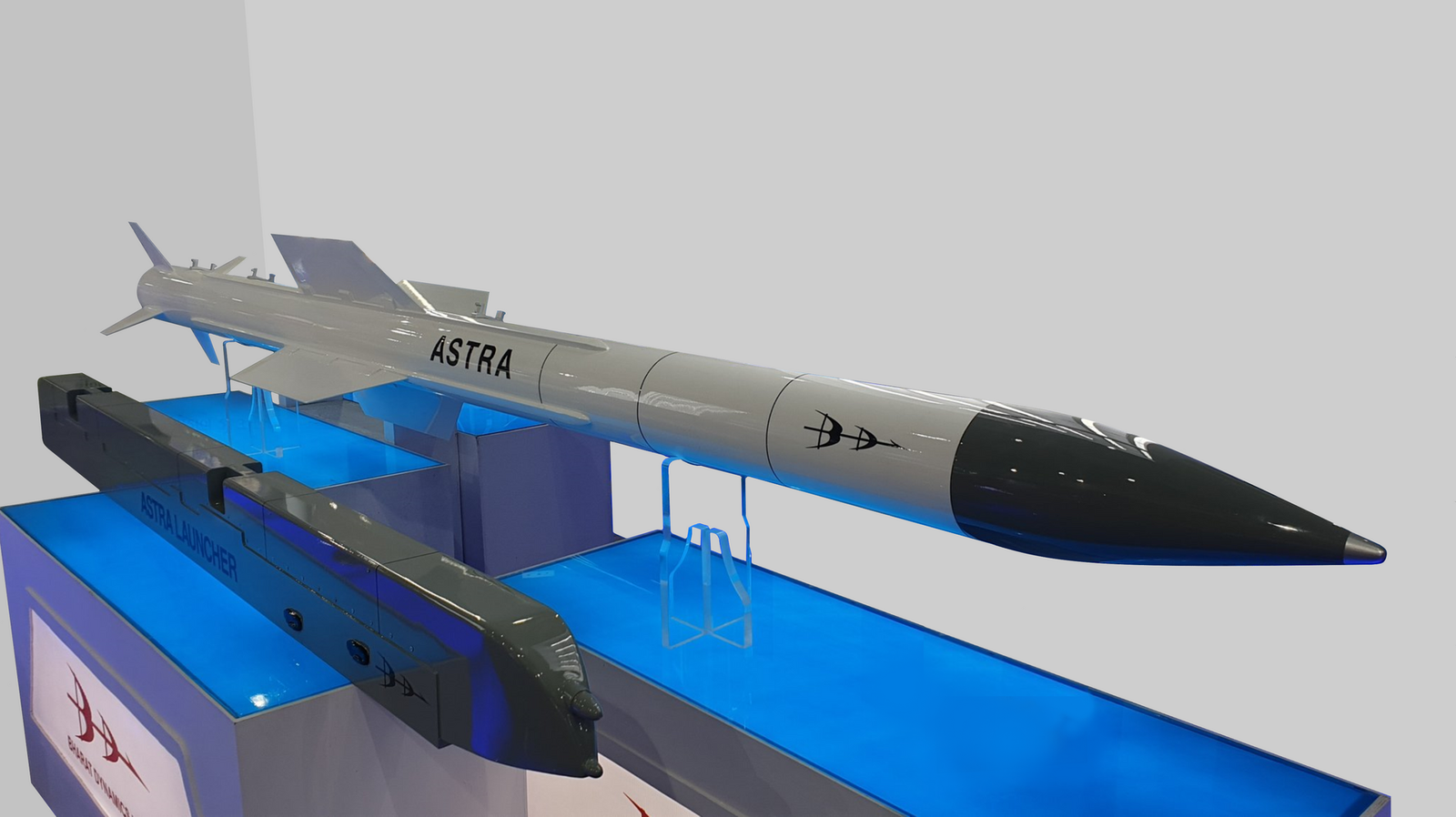
India is opening production of the ASTRA MK-2 beyond government defence PSUs, marking a significant shift in the country’s guided missile manufacturing policy and private sector participation in strategic weapons programmes.
The move signals New Delhi’s intent to accelerate indigenisation and scale production of one of its most operationally proven air-to-air missiles by leveraging private industry capability alongside Defence Research and Development Organisation (DRDO) and Hindustan Aeronautics Limited (HAL) facilities.
The ASTRA MK-2 is an advanced beyond-visual-range (BVR) air-to-air missile developed by DRDO’s Bangalore-based Missiles and Fire Systems division. The original ASTRA entered operational service with the Indian Air Force in 2019 and has been integrated across the IAF’s primary fighter fleet, including the Tejas, Su-30MKI, and Gripen jets.
The MK-2 variant represents a generational upgrade, extending range, improving guidance algorithms, and enhancing counter-measure evasion through advanced seeker technology. The missile’s operational profile makes it central to India’s air superiority doctrine against medium to long-range aerial threats.


Private sector participation in missile manufacturing has historically been restricted in India due to strategic sensitivity and export control regulations. This policy shift reflects confidence in DRDO’s maturity of design and India’s commitment to the Defence Production Policy 2018, which explicitly targets private industry as a co-equal manufacturing partner in defence platforms.
The decision addresses a critical capacity gap. IAF requirements for BVR missiles have expanded with induction of Tejas aircraft and higher serviceability demands across its fighter fleet. Dual-sourcing through private contractors will reduce lead times and production bottlenecks that have historically constrained missile availability during high-tempo operations.
Private firms selected for ASTRA MK-2 production will operate under strict defence procurement protocols, including facility classification, personnel security clearance, and export control compliance monitored by the Defence Ministry and intelligence agencies. Technology transfer from DRDO to private manufacturers will be staged, with initial involvement in sub-assembly and integration before full production responsibility.
This model mirrors successful precedents in artillery ammunition and small arms production, where private ordnance manufacturers have ramped output while maintaining quality benchmarks. The ASTRA MK-2 programme demonstrates that missile systems, once mature in design and operationally proven, can transition to industrial scale-up without compromising strategic security.
The initiative aligns with India’s broader Make in India framework and Atmanirbhar Bharat (self-reliant India) priorities, reducing dependence on import substitution and building export-grade manufacturing capability for air defence systems in the global market.



Facebook Comments