
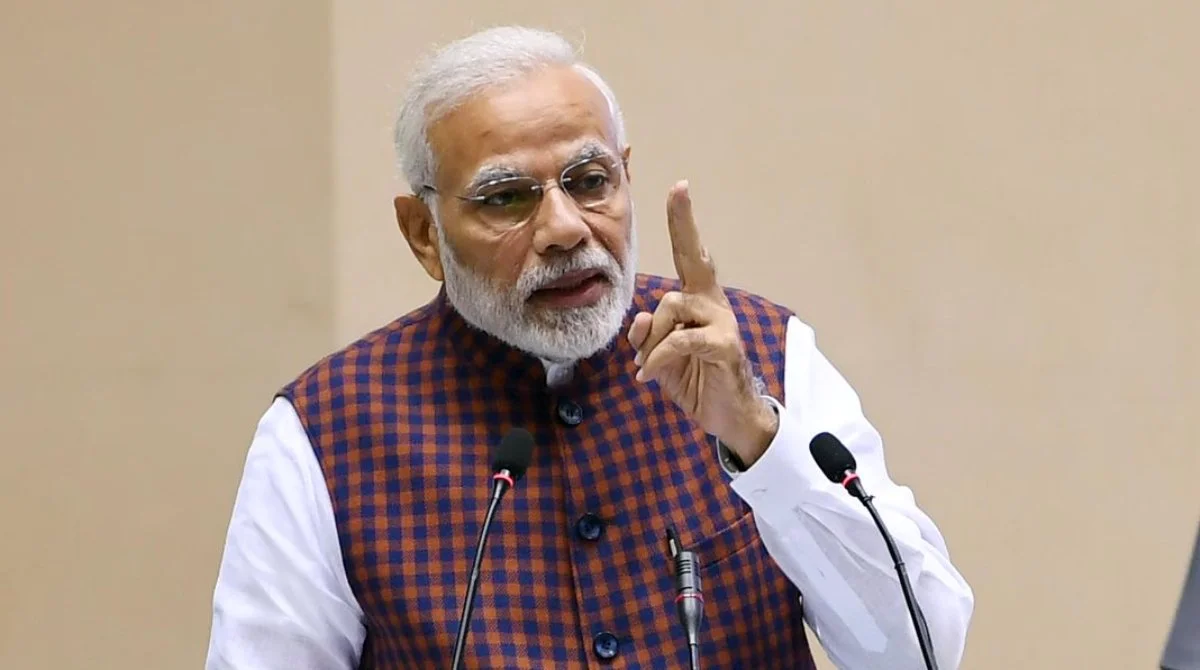
Prime Minister Narendra Modi has signalled India’s commitment to advancing its crewed spaceflight programme Gaganyaan and developing an indigenous space station, moving beyond the recent success of the Chandrayaan lunar missions.
The statement underscores India’s ambition to establish itself as a spacefaring power capable of independent human spaceflight operations and maintaining a permanent orbital research facility. This marks a significant expansion of India’s civil space agenda beyond planetary exploration missions.
Gaganyaan, India’s flagship human spaceflight programme, is being developed by the Indian Space Research Organisation (ISRO) with technical input from the Defence Research and Development Organisation (DRDO). The programme aims to send a three-member Indian astronaut crew to low-Earth orbit for a mission lasting up to seven days, demonstrating India’s capacity in crew life support systems, re-entry technology, and orbital operations.
The first uncrewed Gaganyaan test flight was originally scheduled for 2021 but has since been deferred. ISRO is preparing the spacecraft’s subsystems, including the crew module, service module, and abort system, to ensure crew safety during launch and re-entry. The programme integrates indigenous propulsion systems and thermal protection technologies developed through DRDO laboratories and ISRO centres.

The space station initiative represents the next logical step in India’s human spaceflight roadmap. A dedicated Indian orbital station would reduce dependence on international partners for microgravity research and enable long-term on-orbit activities in materials science, biology, and combustion studies. The station would also serve as a technology demonstration platform for India’s space exploration capabilities.
ISRO has outlined a phased approach to developing the station, beginning with utilisation of modules created during Gaganyaan hardware development. The agency has consulted with Russian space authorities and international partners on best practices for orbital station design, life support systems, and crew operations protocols.
This expansion follows India’s Chandrayaan-3 successful soft landing on the lunar south pole in August 2023, which established India as the fourth nation to execute a controlled landing on the Moon. The achievement reinforced India’s position in space exploration and demonstrated critical technologies for future deep-space missions.
India’s space ambitions align with the government’s broader Make in India and Atmanirbhar Bharat policies, emphasising indigenous capability development across critical technologies including launch vehicles, navigation systems, and spacecraft subsystems. Both Gaganyaan and the space station programme are anchored in Indian industry collaboration and DRDO-ISRO partnership frameworks.




Facebook Comments