
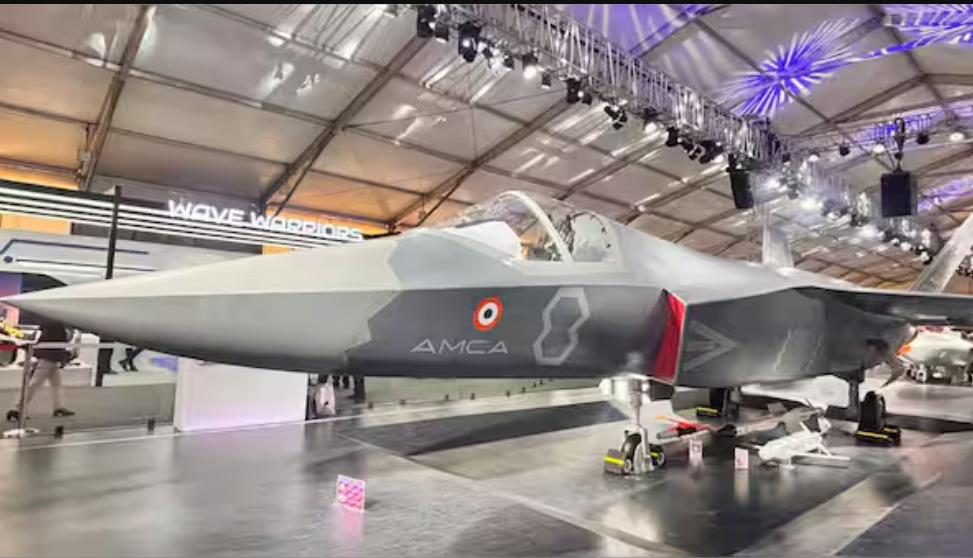
Negotiations between India and General Electric over engines for the Advanced Medium Combat Aircraft (AMCA) have stalled after the US aerospace giant demanded pricing three times higher than India’s budget allocation, according to reports. The setback has prompted the Defence Research and Development Organisation (DRDO) to explore alternative partnerships with the United Kingdom and France for the 5th generation fighter programme.
The AMCA represents the cornerstone of India’s indigenous fighter jet ambition. Designed by HAL’s Aeronautical Development Agency, the twin-engine platform is intended to replace the Mirage 2000 fleet and form the backbone of the Indian Air Force’s combat strength from the 2030s onwards.
Engine development remains the most critical and resource-intensive component of any fighter programme. GE’s F414 and F414-GE-INS6 turbofan variants power the Gripen E and Super Hornet, making them obvious candidates for AMCA’s propulsion architecture. However, the cost of acquiring engine technology transfer rights for production in India has proven a major friction point.
India’s approach to AMCA engine development reflects the broader challenge facing the indigenous fighter programme: balancing indigenous capability with operational urgency. Unlike the Tejas, which relied on American F404 engines from GE, AMCA was originally conceived with indigenous engine development through GTRE’s HTSE (Hindustan Turbofan Super Engine) programme as a long-term objective, with foreign engines bridging the gap.


Engagement with UK and French aerospace firms signals India’s willingness to diversify. Rolls-Royce has supplied engines for naval platforms and trainers, while Safran/SNECMA has proven experience in fighter engine development. Both nations have shown openness to technology partnerships on defence projects with India.
The timing of engine negotiations is critical. AMCA’s first flight is targeted for 2035, with initial operational clearance expected by 2040. Delays in engine finalisation directly impact the airframe development schedule and eventual induction timelines.
This deadlock also underscores a recurring pattern in India’s defence procurement: the gap between India’s willingness to invest and the pricing expectations of international suppliers. Similar tensions have surfaced in other major platforms, from combat helicopters to stealth frigates, where technology transfer clauses and bulk production agreements significantly inflate unit costs.
For the Indian Air Force, the AMCA remains essential. The fighter fleet faces a critical shortage as older platforms retire. The Tejas production is ramping to 40 aircraft by 2029, but AMCA’s larger payload, longer range, and advanced avionics are tailored for contested peer environments in the Indo-Pacific and beyond.


Facebook Comments