
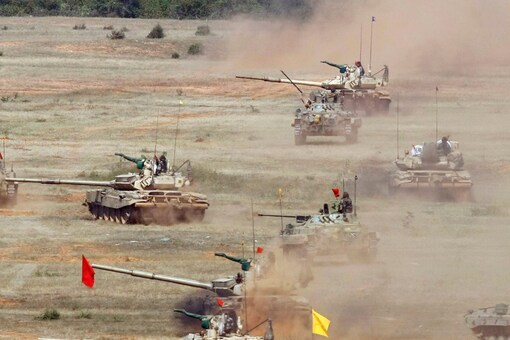
India is developing an indigenous active protection system (APS) for its fleet of T-90 main battle tanks to counter anti-tank missiles and unmanned aerial vehicles, according to defence sources. The system represents a significant step toward reducing dependence on imported technologies for tank survivability.
Active protection systems represent a critical layer in modern tank defence architecture. These systems detect incoming threats, including guided anti-tank missiles and drone-delivered munitions, and deploy countermeasures such as explosive charges or projectile clouds to neutralise or deflect the incoming threat before it strikes the hull.
The T-90 has formed the backbone of the Indian Army’s main battle tank fleet since the 1990s. Over 2,000 T-90S variants have been inducted, making it the primary medium for mechanised warfare in Indian ground operations. The original Russian Kontakt-5 explosive reactive armour (ERA) on the T-90 provides protection against kinetic and shaped-charge warheads, but an APS would offer enhanced survivability against evolving anti-armour threats.
India’s move toward indigenous APS development aligns with the broader Make in India defence policy and the military’s emphasis on self-reliance in critical weapon systems. DRDO laboratories have been tasked with developing the system, which would integrate sensor suites, targeting algorithms, and rapid-response countermeasure deployment mechanisms.

Global militaries have already fielded active protection systems. Russia’s Afganit APS equips the T-90M variant, while Israeli Trophy system has been integrated on tanks and armoured vehicles operated by multiple armies. Germany’s ADS and South Korea’s KAPS represent additional references for threat detection and neutralisation philosophies.
The development timeline and performance benchmarks for the Indian system remain subject to field testing and validation protocols. Integration with the T-90’s fire control system, power architecture, and turret configuration will require detailed engineering coordination between DRDO and OFB facilities.
The T-90 operates across varied terrain on the Indian subcontinent, from the Siachen glacier to desert and plains environments. An APS designed for Indian operational conditions must account for dust ingestion, extreme temperature variations, and high altitude performance. These environmental factors influence sensor reliability and countermeasure effectiveness.
This development also signals India’s recognition of drone threats in contemporary warfare. Recent conflicts in Ukraine and the Middle East have demonstrated the vulnerability of armoured vehicles to loitering munitions and drone-launched anti-tank guided missiles. An APS provides a defensive countermeasure that complements electronic warfare systems and reactive armour configurations.




Facebook Comments