
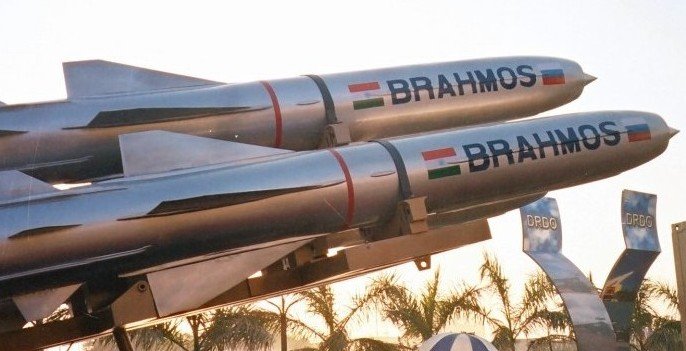
India and Russia are jointly developing smaller, hypersonic variants of the BrahMos cruise missile to expand the weapon system’s operational reach and strike precision across multiple platforms, according to BrahMos Aerospace officials.
The new variants form part of a broader modernisation roadmap for the BrahMos family, which has emerged as one of India’s most versatile and operationally proven air-breathing cruise missile systems since its induction into the Indian Air Force in 2005.
BrahMos Aerospace, the joint venture between India’s Defence Research and Development Organisation (DRDO) and Russia’s NPO Mashinostroyenia, is envisioning a 1,500-kilometre supersonic cruise missile variant designed to bolster India’s deep-strike capabilities. This extended-range configuration would significantly enhance the weapon’s ability to engage targets at strategic distances while maintaining the system’s hallmark supersonic speed and terminal guidance accuracy.
The current BrahMos missile family operates across air, land, and sea-based platforms. The air-launched variant, integrated into IAF Sukhoi Su-30MKI fighters, has a range of 290 kilometres. The ground-launched Brahmos (GLCMs) deployed with the Indian Army operate at 290-350 kilometre ranges, while the naval variant extends to 290 kilometres from ship-based launchers deployed on Indian Navy destroyers and frigates.


The development of hypersonic variants addresses a critical gap in India’s precision strike inventory. While the standard BrahMos achieves Mach 2.8 to 3, hypersonic versions would operate at speeds exceeding Mach 5, reducing response time and significantly complicating adversary air defence interception. Russia’s own hypersonic programmes, including the Kinzhal air-launched system and ground-based Avangard, have demonstrated operational feasibility of such speeds at strategic ranges.
Smaller variants would allow integration onto additional platforms beyond the current Su-30MKI, potentially enabling deployment from lighter fighter aircraft and expanding tactical flexibility. This aligns with India’s broader strategy of creating a networked, multi-layered strike capability spanning conventional and precision-guided munitions.
The BrahMos programme exemplifies India’s approach to defence indigenisation through international partnership. While DRDO provides developmental and integration expertise, Russian technological input on ramjet propulsion, guidance systems, and materials science has been instrumental in achieving the missile’s operational performance benchmarks.
India has conducted extensive operational trials of BrahMos variants across the Arabian Sea, the Bay of Bengal, and over land ranges in Odisha and Rajasthan. The system has demonstrated consistent terminal accuracy and reliability metrics that have influenced procurement decisions by the three services.
Development timelines for the new hypersonic variants remain dependent on joint Russian-Indian testing protocols and integration milestones with naval and air force platforms. The capability upgrade would position India’s strike arsenal alongside contemporary systems operated by peer defence forces.




Facebook Comments