
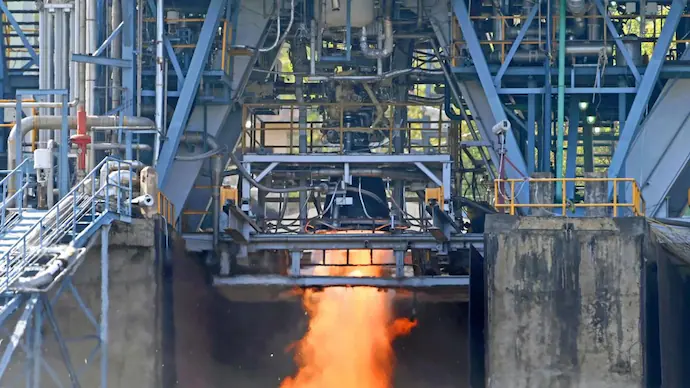
The Indian Space Research Organisation (ISRO) has successfully completed the Flight Acceptance Test (FAT) of the CE20 cryogenic engine designated for the upcoming LVM3 mission. The successful qualification confirms that the engine is fully prepared for operational deployment aboard India’s heavy-lift launch vehicle.
The CE20 powers the cryogenic upper stage of the LVM3 (Launch Vehicle Mark 3), India’s most powerful operational launch vehicle. Using liquid hydrogen as fuel and liquid oxygen as the oxidizer, the engine generates around 20 tonnes of thrust in the vacuum of space. It has been designed and developed entirely by ISRO’s Liquid Propulsion Systems Centre (LPSC) in Thiruvananthapuram, reflecting the country’s indigenous capabilities in advanced rocket propulsion.
The Flight Acceptance Test is a crucial stage in the certification process for every flight engine. It verifies that the CE20 meets all structural, functional, and performance requirements before integration with the launch vehicle’s cryogenic upper stage. Prior to this milestone, the engine underwent a series of rigorous ground evaluations, including extensive hot-fire testing under simulated operational conditions.
The LVM3 has become the backbone of India’s heavy-lift launch programme. The three-stage launch vehicle is capable of placing payloads of up to four tonnes into Geosynchronous Transfer Orbit (GTO) and significantly heavier satellites into Low Earth Orbit (LEO). Its configuration consists of two solid strap-on boosters, a liquid-propellant core stage, and the CE20-powered cryogenic upper stage. Since its maiden flight in December 2014, the LVM3 has successfully supported multiple satellite launches and strategic space missions.


The development of indigenous cryogenic propulsion has been one of ISRO’s most significant technological achievements. The CE20 engine represents decades of sustained research and engineering, enabling India to achieve self-reliance in high-energy rocket propulsion. Its successful development also marked a shift away from dependence on foreign cryogenic engine technology used during the early phases of the GSLV programme.
The successful acceptance test further strengthens ISRO’s preparations for a series of upcoming LVM3 missions, including commercial launches that will be carried out through NewSpace India Limited (NSIL). At the same time, India’s expanding private space sector is increasingly contributing to the production of launch vehicle components, including solid rocket boosters and various subsystems, supporting a broader domestic space manufacturing ecosystem.
With the successful qualification of the CE20 engine, India continues to strengthen its position among the limited number of nations possessing indigenous cryogenic launch capabilities, joining countries such as the United States, Russia, China, Japan, and members of the European Space Agency. The latest milestone highlights the reliability of India’s heavy-lift launch programme and reinforces the country’s growing role in the global space sector.




Facebook Comments