
IAF Launches Indigenous Kamikaze Drone Programme, Establishes Development Hub at Sulur
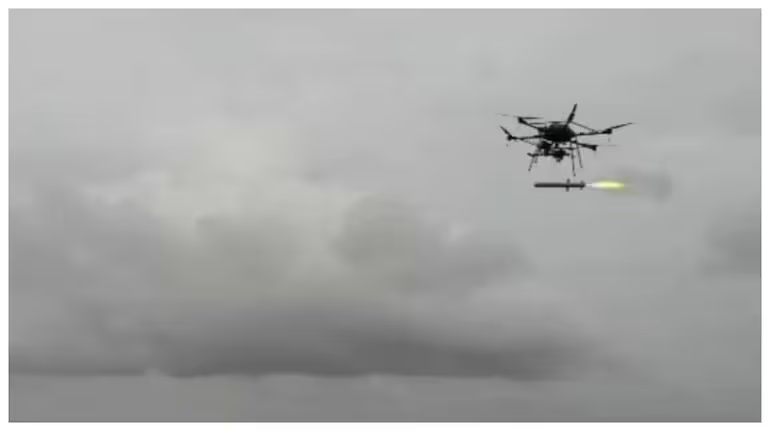
The Indian Air Force has launched an indigenous kamikaze drone programme and plans to establish a dedicated development hub at Sulur in Tamil Nadu, according to reports. The move marks a significant step in India’s push to develop loitering munitions as part of its broader indigenisation of aerial combat systems.
Sulur, home to the Air Force Station near Coimbatore, has been selected as the location for this specialised facility. The base houses critical air defence and avionics testing infrastructure, making it a logical choice for developing and validating unmanned aerial systems designed for precision strike roles.
Kamikaze drones, or loitering munitions, represent a category of autonomous or remotely piloted aerial weapons that can circle a target area and strike with precision when the optimal moment arrives. Unlike conventional missiles with fixed trajectories, these systems offer flexibility in target engagement and can loiter over battlefields for extended periods before initiating their attack run.
The IAF’s initiative aligns with India’s broader Make in India defence strategy and the national focus on reducing dependence on imported weapons platforms. DRDO, India’s primary defence research agency, has been actively exploring autonomous and semi-autonomous systems across multiple domains, including aerial platforms. This programme builds on earlier experimentation with tactical unmanned systems and precision-guided munitions.


Loitering munitions have gained strategic relevance following their operational use in recent regional conflicts, where they have demonstrated effectiveness against stationary and slow-moving targets including air defence systems, vehicles, and fortified positions. Several countries have accelerated development programmes to acquire or enhance indigenous loitering munition capabilities.
For the IAF, such a system would fill a capability gap between conventional stand-off weapons and traditional air-to-surface munitions. A dedicated development hub at Sulur would facilitate rapid prototyping, testing, and validation cycles, reducing overall development timelines and enabling quick integration with IAF platforms and operational doctrine.
The establishment of a focused development facility also supports India’s growing defence ecosystem by creating specialised technical expertise and infrastructure at a single location. This concentration approach has proven effective in other DRDO-led programmes, where dedicated centres have accelerated indigenisation of complex military systems.
The IAF currently operates the Heron and Heron TP unmanned aircraft for surveillance missions. Indigenous kamikaze drone development would extend India’s unmanned systems portfolio into the armed loitering category, reducing reliance on foreign platforms for precision strike capabilities in future air operations.




Facebook Comments