
India is moving steadily towards achieving a major milestone in space exploration through the Indian Space Research Organisation’s (ISRO) Gaganyaan programme. The ambitious mission aims to demonstrate the country’s ability to independently send Indian astronauts into Low Earth Orbit and safely return them to Earth using indigenous space technology. The programme is an important step in strengthening India’s human spaceflight capabilities and expanding its presence in the global space sector.
Four Indian Air Force officers have been selected as astronaut-designates for the Gaganyaan mission. They are Group Captain Prasanth Balakrishnan Nair, Group Captain Ajit Krishnan, Group Captain Angad Pratap and Group Captain Shubhanshu Shukla. Prime Minister Narendra Modi officially introduced the four officers on February 27, 2024, during his visit to the Vikram Sarabhai Space Centre in Thiruvananthapuram, Kerala. They were also presented with astronaut wings in recognition of their selection.
The four astronaut-designates have extensive experience as fighter pilots and underwent a demanding selection process involving physical fitness assessments, medical examinations and psychological evaluations. Their aviation backgrounds and specialised training are essential for handling the challenges associated with human spaceflight. Shubhanshu Shukla also gained valuable spaceflight experience after participating in the Axiom Mission 4 to the International Space Station in 2025.
The Gaganyaan programme aims to send a crew of three astronauts into an orbit approximately 400 kilometres above Earth for a mission lasting up to three days. Following the mission, the astronauts will return aboard a specially designed Crew Module, which will perform a controlled descent before splashing down in Indian sea waters.
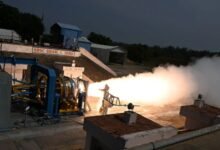
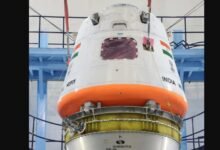
For this mission, ISRO is developing the Human Rated Launch Vehicle Mark-3 (HLVM3), a modified version of its LVM3 rocket. The spacecraft’s Orbital Module consists of two main components: the Crew Module, which provides a habitable environment for astronauts, and the Service Module, which supplies propulsion, power and other essential support systems.
ISRO has achieved important milestones in developing the technologies required for the mission. According to a government update presented by Union Minister Dr Jitendra Singh in the Rajya Sabha on August 6, 2026, the Crew Module and Service Module propulsion systems have been developed, tested and qualified. Other critical systems, including thermal protection, environmental control and life support, deceleration mechanisms and onboard avionics, have also undergone development and testing.
Safety remains a major priority throughout the programme. ISRO successfully completed the TV-D1 test vehicle mission, demonstrating the performance of the Crew Escape System. Two Integrated Air Drop Tests have also helped validate the Crew Module’s parachute-based deceleration system. Preparations for the TV-D2 test vehicle mission were reported to be underway.
Before sending astronauts into space, ISRO plans to conduct three uncrewed missions to evaluate the spacecraft and its essential systems. The first uncrewed experimental mission, G1, was targeted for the fourth quarter of 2026 and is expected to carry Vyommitra, ISRO’s half-humanoid robot. Two additional uncrewed missions are planned before the first crewed orbital flight, with the government outlining a target of completing them by 2027.
Beyond Gaganyaan, India has also outlined ambitious long-term space exploration plans, including the establishment of the Bharatiya Antariksh Station by 2035. The proposed space station will strengthen India’s ability to conduct advanced scientific research and long-duration human spaceflight activities.
With astronaut preparation, launch vehicle development and spacecraft testing progressing, the Gaganyaan programme is laying the foundation for India’s independent human spaceflight capabilities. Successful completion of the upcoming uncrewed missions will be a crucial step towards carrying Indian astronauts into space and opening a new chapter in the country’s space exploration journey.
Facebook Comments