
The Indian Air Force (IAF) has showcased its expanding aviation capabilities and disaster-response strength during Sahayata Setu 2026, a multinational Humanitarian Assistance and Disaster Relief (HADR) exercise conducted at Air Force Station Jamnagar in Gujarat from November 17 to 19. The three-day exercise brought together India’s Army, Navy, Air Force, Coast Guard, national disaster-management agencies and representatives from 24 friendly foreign countries.
Conducted under the guidance of Headquarters Integrated Defence Staff (HQ IDS) and Headquarters South Western Air Command (HQ SWAC), the exercise focused on improving coordination between military forces, government agencies and international partners during major emergencies. Its activities highlighted India’s ability to use military aviation, specialised equipment and joint operational planning to support disaster-affected communities.
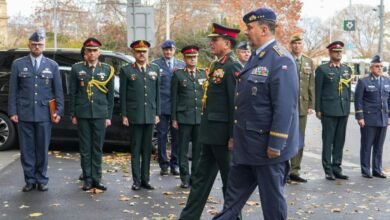
The concluding day featured a Multi-Agency Capability Demonstration (MACD), providing a practical display of coordinated operations across air, land and maritime environments. Chief of Defence Staff General N S Raja Subramani attended the event as the chief guest, accompanied by Chief of the Air Staff Air Chief Marshal Ashutosh Dixit and other senior military and civilian officials.
Several aircraft and helicopters participated in the demonstration, reflecting the diverse operational capabilities available to India’s armed forces. The Indian Air Force deployed Jaguar fighter aircraft, C-130J Super Hercules transport aircraft, Mi-17 helicopters and remotely piloted quadcopters. The Jaguar aircraft demonstrated tactical and photographic reconnaissance, showing how aerial surveillance can help identify affected locations and assess emergency situations.
The C-130J Super Hercules highlighted its tactical airlift capabilities, which are essential for transporting personnel and equipment to locations where conventional transportation infrastructure may be unavailable. Mi-17 helicopters also demonstrated multiple disaster-response roles. An Mi-17 V5 helicopter showcased aerial firefighting using a water bucket, while another Mi-17 1B demonstrated the transportation of an Army vehicle.
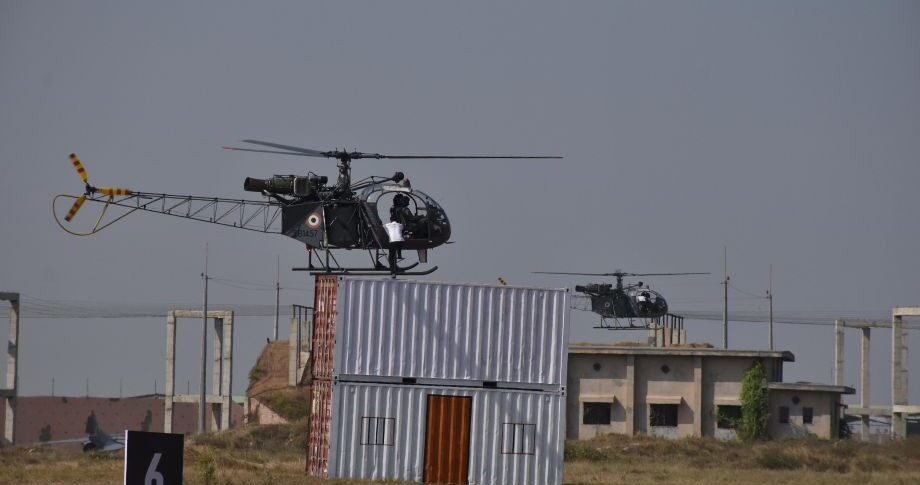
The Chinook heavy-lift helicopter demonstrated its ability to transport large equipment, including bridge components, supporting the restoration of connectivity in disaster-hit areas. Advanced Light Helicopters operated by the three armed services also participated, alongside the Indian Navy’s Dornier aircraft and the Indian Air Force’s Cheetah helicopters.
A specialised airborne demonstration was conducted by the Indian Air Force’s Combat Free Fall Rapid Response Force personnel, who carried out a parachute jump from an AN-32 aircraft. The activity highlighted the importance of rapidly deploying trained personnel during emergency situations.
Beyond aircraft demonstrations, Sahayata Setu 2026 emphasised international cooperation and joint disaster preparedness. Representatives from 24 countries associated with regional and international partnerships, including the Indian Ocean Rim Association (IORA), BIMSTEC and the Quadrilateral Security Dialogue (QUAD), participated in the exercise.
The programme included seminars, tabletop exercises, equipment displays and discussions on improving disaster-management coordination. A meeting of the QUAD Humanitarian Assistance and Disaster Relief Working Group also took place, reinforcing cooperation among partner nations.
Addressing the gathering, General N S Raja Subramani stressed the importance of a coordinated whole-of-nation approach to disaster management. He highlighted India’s role as a dependable first responder in the Indian Ocean Region and Indo-Pacific, supported by its Neighbourhood First policy and MAHASAGAR vision. He also referred to humanitarian missions such as Operation Dost in Türkiye and Operation Brahma in Myanmar.
Sahayata Setu 2026 demonstrated that modern air power has an important role beyond conventional military operations. By combining advanced aircraft, specialised rescue capabilities, technological innovation and international partnerships, India continues to strengthen its preparedness for humanitarian emergencies and complex disaster-response missions.
Facebook Comments