
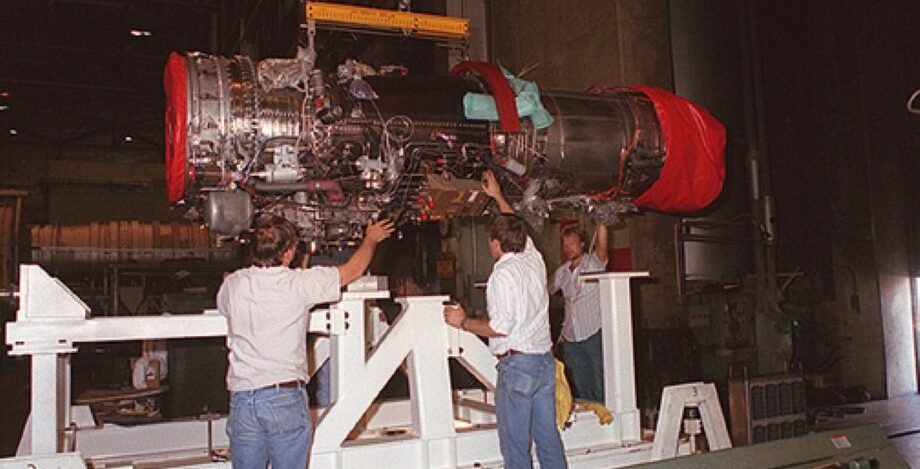
India’s proposed partnership with American aerospace giant General Electric (GE) Aerospace to manufacture F414 fighter jet engines domestically is facing an important financial and strategic debate. The reported $800 million investment requirement for establishing a dedicated manufacturing and assembly facility in India has brought renewed attention to the actual cost of technology transfer and the country’s ambitions to develop an independent aerospace manufacturing ecosystem.
The proposed investment, estimated at approximately ₹7,600 crore in recent reports, is expected to support the domestic production of F414 engines that will power several important future combat aircraft programmes. These include the Light Combat Aircraft (LCA) Tejas Mk2, the Advanced Medium Combat Aircraft (AMCA) Mk1 and the proposed Twin Engine Deck Based Fighter (TEDBF) for the Indian Navy.
For India, the importance of the agreement goes beyond acquiring another fighter jet engine. It represents an opportunity to gain manufacturing experience in one of the most technologically challenging areas of military aviation. However, the financial terms and the depth of technology transfer will determine whether the arrangement delivers meaningful long-term benefits.
The F414 engine is a proven afterburning turbofan in the approximately 98-kilonewton thrust class. It has been selected for the Tejas Mk2 and is also planned to power the initial version of India’s fifth-generation AMCA fighter. Its selection provides a common propulsion solution for multiple aircraft programmes, potentially creating long-term demand for domestically manufactured engines.

The partnership between GE Aerospace and Hindustan Aeronautics Limited (HAL) dates back to June 2023, when both companies signed a memorandum of understanding during Prime Minister Narendra Modi’s visit to the United States. The agreement opened the way for potential joint production of F414 engines in India. Subsequent discussions have focused on manufacturing arrangements, technology sharing and commercial conditions.
One of the major issues is the reported increase in the projected price of individual engines. Earlier estimates placed the cost at approximately ₹70–80 crore per engine, while reports during the commercial negotiations have indicated figures exceeding ₹200 crore. Such a substantial difference could influence the overall expenditure of India’s future fighter programmes, particularly when hundreds of engines may be required over their operational lifetimes.
The proposed $800 million facility investment adds another dimension to these negotiations. While establishing a dedicated production line would require significant initial capital, supporters argue that the investment should be evaluated against the long-term requirements of the Indian Air Force and Navy rather than the cost of the first few engines alone. A domestic production facility could help strengthen supply-chain resilience, improve maintenance support and reduce dependence on overseas manufacturing schedules.
However, the central question remains how much critical technology India will actually receive. Manufacturing and assembling an engine domestically does not automatically provide complete control over its design, upgrades or sensitive technologies. Indian defence planners are particularly interested in developing deeper capabilities in advanced materials, turbine manufacturing, precision engineering and other specialised areas associated with modern jet propulsion systems.
This distinction is particularly important because India wants to move beyond assembling foreign-designed equipment towards developing its own advanced aero-engine technology. The success of the F414 partnership will therefore depend not only on production numbers but also on the level of technical expertise and industrial capability transferred to Indian manufacturers.
Recent developments also indicate that the F414 discussions involve separate procurement requirements. According to an October 2026 report by IDRW, the Aeronautical Development Agency (ADA) is pursuing a separate requirement for approximately 14–15 F414 engines for the initial AMCA prototype programme. This procurement track is distinct from the proposed HAL-led domestic manufacturing arrangement, highlighting the different requirements of aircraft development and future serial production.
The issue also has implications for India’s broader engine development ambitions. The Defence Research and Development Organisation (DRDO), particularly its Gas Turbine Research Establishment (GTRE), has been working towards developing indigenous high-thrust aero-engine capabilities. A future domestic engine in the 110–120 kN thrust category is considered important for India’s next-generation fighter requirements.
International companies such as France’s Safran and the UK’s Rolls-Royce have also featured in discussions concerning India’s future fighter engine development partnerships. These options underline New Delhi’s interest in expanding technological cooperation while gradually building domestic expertise.
For the immediate future, the GE F414 remains an important propulsion option for the Tejas Mk2 and AMCA Mk1 programmes. Any major change in engine selection would involve additional aircraft integration, engineering modifications and testing, potentially affecting development schedules.
Ultimately, the reported $800 million proposal should be judged on the industrial and technological value it creates for India. If the agreement delivers competitive engine pricing, meaningful technology transfer and substantial domestic manufacturing capabilities, it could become an important milestone in India’s aerospace development. If these conditions are not achieved, the country could face the risk of investing heavily in a facility while continuing to depend on foreign technology for its most critical engine requirements.
As negotiations move towards their next stage, the challenge for India will be to balance immediate fighter aircraft requirements with its long-term objective of achieving genuine self-reliance in military aviation propulsion.




Facebook Comments