
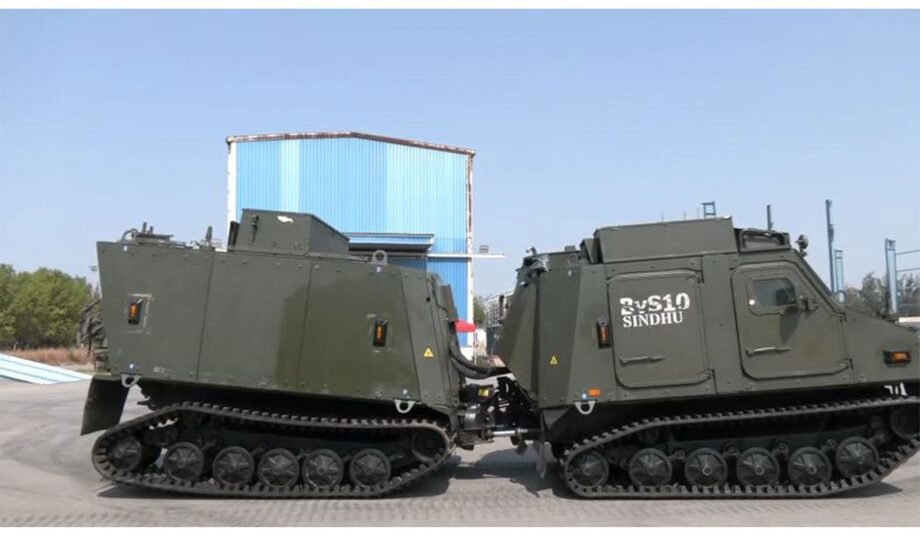
Larsen & Toubro (L&T) and BAE Systems have commenced production of the BvS10 Sindhu articulated all-terrain vehicle for the Indian Army, marking an important milestone in India’s efforts to enhance military mobility across challenging border regions.
Manufacturing has begun at L&T’s Armoured Systems Complex in Hazira, Gujarat, following an Indian Army contract signed in November 2025 for an initial batch of 18 vehicles. The vehicles are intended for operations in Ladakh and the Kutch region, where extreme weather conditions and difficult terrain create significant logistical challenges for military forces.
The BvS10 Sindhu is an India-specific variant of the established BvS10 platform developed by BAE Systems Hägglunds. The programme combines L&T’s domestic manufacturing capabilities with technical and design support from its international partner, supporting India’s broader Make in India initiative in defence manufacturing.
Designed to operate in demanding environments, the vehicle is intended to handle high-altitude snowfields, rocky mountain tracks, desert terrain and marshlands. In Ladakh, it is expected to support operations at altitudes of up to 18,000 feet, where temperatures can fall to approximately minus 55 degrees Celsius. In Kutch, its capabilities are intended to help military personnel navigate marshy ground and extreme summer temperatures.
A key feature of the BvS10 Sindhu is its articulated design, which enables the connected vehicle sections to manoeuvre across uneven and unstable surfaces. Its amphibious capability also allows it to negotiate suitable waterways, offering additional flexibility in areas where conventional vehicles may face mobility limitations.
The BvS10 platform can support various military roles, including troop transportation, logistics, command and control, medical evacuation and recovery operations, depending on the configuration. These capabilities could help the Indian Army improve the movement of personnel, equipment and supplies across difficult operational areas.
The commencement of production also highlights the growing importance of international defence partnerships in strengthening India’s domestic industrial capabilities. Under the programme, L&T will manufacture the vehicles at its Hazira facility, while BAE Systems Hägglunds will provide technical and design assistance. Integrated logistics support is also part of the arrangement to help sustain the vehicles throughout their service life.
The BvS10 family is already operated by several foreign armed forces, providing an established background for the platform. The Sindhu variant has been tailored to Indian requirements, with trials conducted in different geographical and climatic conditions.
For the Indian Army, the introduction of specialised all-terrain vehicles could improve operational flexibility in border areas where mountains, snow, sand and marshland restrict conventional transport. The planned deployment in Ladakh and Kutch reflects the need for equipment capable of operating across India’s diverse and demanding terrain.
With manufacturing now underway, the next major milestone will be the delivery and induction of the vehicles into Army service. The start of production marks progress in the programme, although a confirmed delivery schedule has not been established in the publicly available information.
The BvS10 Sindhu programme represents a significant development in India’s specialised military mobility and defence manufacturing efforts. Once inducted, the vehicles are expected to provide the Indian Army with an additional capability for transporting troops and supplies through some of the country’s most challenging border environments.

Facebook Comments