
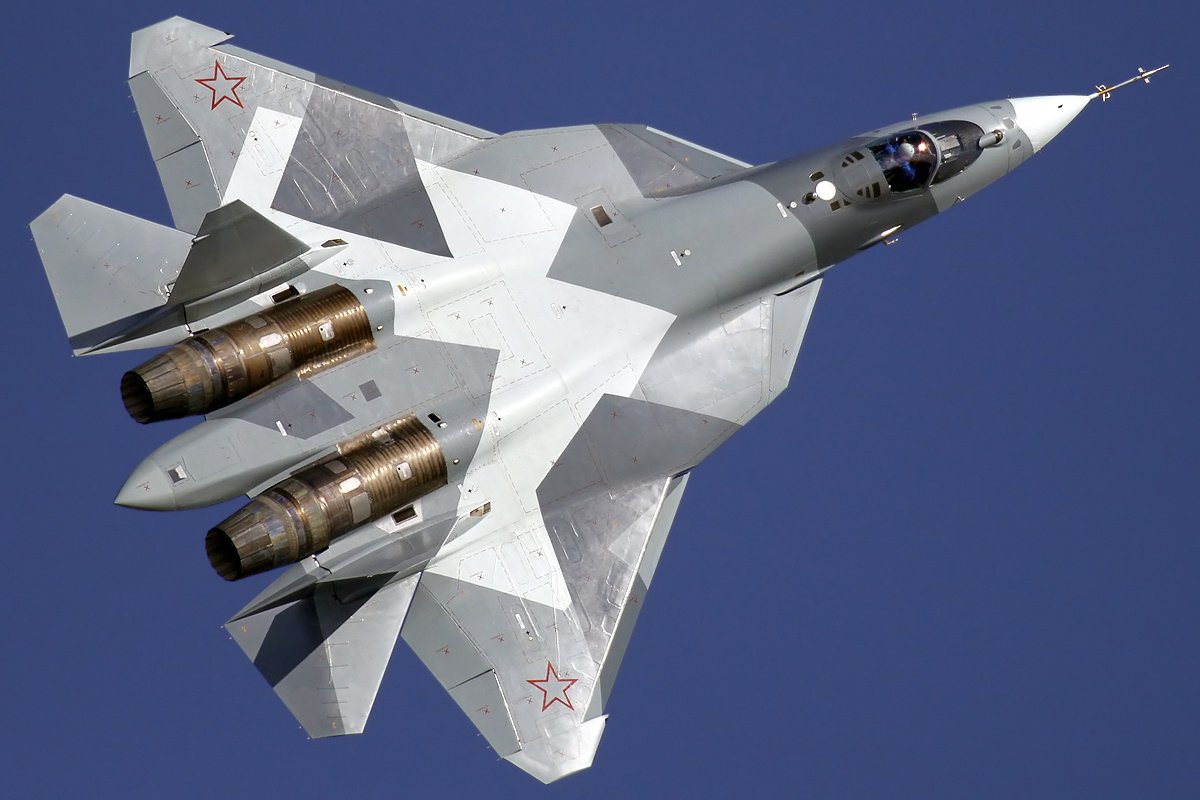
Russia’s offer of the Su-57E stealth fighter has found renewed traction within Indian defence circles as delays in securing American General Electric engines for India’s indigenous HAL Tejas Mark II programme continue to create procurement uncertainties.
The Su-57E, an export variant of Russia’s fifth-generation Sukhoi Su-57 Felon, represents a significant capability leap from the Su-30MKI heavy fighters that have anchored India’s air superiority fleet for over two decades. Unlike its predecessor, the Su-57E incorporates refined aerodynamics, advanced sensor fusion, and improved stealth characteristics designed to counter contemporary air defence systems.
India’s interest in the Su-57E must be viewed against the backdrop of the Indian Air Force’s long-standing modernisation strategy. The service operates around 272 combat aircraft across multiple platforms including the Su-30MKI, Mirage 2000, MiG-29, and the newly inducted HAL Tejas Mark I. The induction timeline for the Tejas Mark II, equipped with a more powerful engine and enhanced avionics, has faced headwinds due to engine sourcing complications with General Electric.
The Tejas Mark II programme, led by HAL and the Defence Research and Development Organisation, seeks to deliver a 4.5-generation fighter with supercruise capability and greater combat radius. The aircraft’s developmental trajectory has been closely monitored given India’s larger Make in India strategy, which prioritises indigenous aerospace manufacturing and reduces dependence on foreign weapon systems for critical platforms.
The Su-57E offer from Russia provides India with an alternative pathway to fifth-generation air combat capability without the engine delays that have constrained domestic programmes. Russia has actively marketed the platform to potential export customers, though the actual technical specifications available to foreign governments remain subject to strict limitations on sensor and avionics disclosure.
India’s defence procurement strategy has historically balanced indigenous capability development with foreign acquisitions. The Su-30MKI itself, a product of HAL-Sukhoi collaboration beginning in 1996, demonstrated this model. However, successive governments have placed greater emphasis on in-house design and manufacture to reduce operational costs and build indigenous expertise.
Any decision on the Su-57E would require careful assessment of integration compatibility with existing Indian Air Force infrastructure, logistics chains, and training ecosystems. The service’s operational doctrine has evolved around Russian and Western platforms; introducing fifth-generation systems demands substantial investments in pilot training, maintenance protocols, and air defence integration.
The timing of renewed Russian overtures also reflects broader geopolitical positioning. India maintains a strategic partnership with Russia in defence manufacturing and has been a consistent buyer of Russian military equipment. Simultaneously, India’s defence ties with Western nations, particularly the United States, have deepened through defence technology-sharing agreements and joint exercises.
Defence Ministry officials will need to weigh immediate air superiority gaps against longer-term indigenisation objectives and the diplomatic implications of platform choices in the current strategic environment.
Facebook Comments