
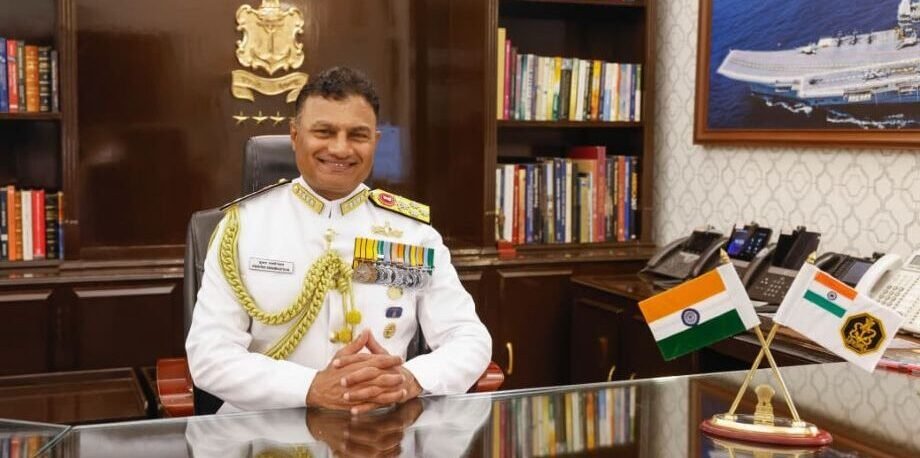
The Pakistani Navy’s PNS Hunain sustained significantly more damage than India’s INS Kolkata following a collision in the North Arabian Sea in September, Indian Navy Chief Admiral Krishna Swaminathan has disclosed. His remarks came during the ANI National Security Summit 3.0 held in New Delhi on November 16, offering further details about the maritime incident.
According to Admiral Swaminathan, the collision took place when the Pakistani naval vessel came dangerously close to the Indian destroyer during manoeuvring operations. He indicated that the approach by PNS Hunain created a difficult situation, eventually resulting in contact between the two warships.
The incident occurred while INS Kolkata was deployed as part of Operation Urja Suraksha. The Indian Navy had positioned its warship near the mouth of the Gulf of Oman to support and protect Indian merchant vessels operating through the strategically important maritime region, particularly around the Strait of Hormuz.
Describing the circumstances, the Navy Chief explained that naval vessels sometimes operate close to one another during maritime manoeuvres. However, maintaining a safe distance remains essential to prevent accidental encounters. In this particular case, PNS Hunain reportedly moved too close to INS Kolkata, creating the conditions for a collision.
Admiral Swaminathan indicated that the Pakistani vessel attempted to change its course at the last moment to avoid the Indian destroyer. However, the manoeuvre did not prevent the impact. Despite the collision, INS Kolkata escaped with limited consequences, while the Pakistani warship suffered considerably greater damage.
The Navy Chief also pointed out that assessing the complete damage to the Pakistani vessel was challenging because PNS Hunain subsequently left the area and returned to its home port. When questioned about whether the ship remained under repair more than two months after the incident, he did not disclose additional information.
The collision drew attention because it involved naval vessels belonging to two neighbouring countries with longstanding strategic differences. The incident also highlighted the importance of professional navigation and adherence to maritime safety practices, especially in busy international shipping corridors.
During his interaction at the summit, Admiral Swaminathan addressed another significant maritime development involving the sinking of an Iranian warship by a US submarine in 2026. The Iranian vessel had earlier participated in India’s International Fleet Review in Visakhapatnam in February before heading back towards Iran.
The Navy Chief described the circumstances as awkward, considering the Iranian warship had recently attended an international naval event hosted by India. However, he clarified that the vessel was outside Indian territorial waters when it was attacked during the US-Iran conflict.
He further explained that India’s territorial waters extend 12 nautical miles from its coastline and that the Iranian vessel was operating in international waters at the time. He avoided commenting on the justification for the American military action, stating that such an assessment was a matter for the US Navy.
Admiral Swaminathan’s latest comments have brought renewed attention to the September encounter between INS Kolkata and PNS Hunain. His account reinforces the Indian Navy’s position that the Pakistani vessel experienced substantially greater damage, while the Indian destroyer continued its operational responsibilities in the region.



Facebook Comments