
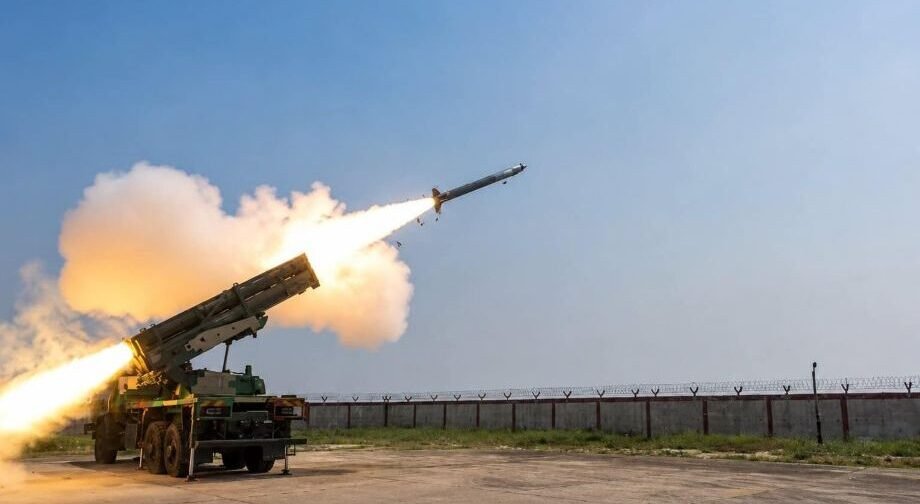
India has taken another step towards strengthening its long-range artillery capabilities following fresh firing trials of the SURYASTRA Universal Rocket Launcher System. Pune-based defence manufacturer NIBE Limited reportedly conducted the latest trials on November 11, 2026, at the Integrated Test Range (ITR) in Chandipur, Odisha. The demonstrations covered four different firing ranges of 30 km, 50 km, 150 km and 300 km, highlighting the system’s multi-range operational capabilities.
The latest development represents an important milestone in India’s efforts to strengthen its domestic defence industry and reduce dependence on foreign military equipment. SURYASTRA is designed as a multi-calibre rocket launcher capable of operating with different types of ammunition from a common launch platform. This approach provides greater flexibility to military formations by allowing them to select suitable rocket configurations according to operational requirements and target distances.
Developed by NIBE Limited through a technology collaboration with Israel-based defence company Elbit Systems, SURYASTRA draws on the latter’s Precise and Universal Launching System (PULS) architecture. The collaboration agreement was signed in July 2025 to support the system’s manufacturing in India. The programme combines established launcher technology with domestic production capabilities, supporting India’s broader Make in India and Aatmanirbhar Bharat objectives.
The system’s ability to accommodate different rocket types makes it a potentially valuable addition to modern artillery operations. Rather than depending on separate launch platforms for different engagement distances, the universal launcher concept allows forces to use a common system for multiple mission profiles. Its truck-mounted configuration also offers mobility, allowing military units to reposition after firing and improve their operational flexibility.
SURYASTRA had previously demonstrated its long-range capabilities during firing trials at Chandipur on May 18 and 19, 2026. According to NIBE’s May announcement, the 150-km rocket achieved a Circular Error Probable (CEP) of 1.5 metres, while the 300-km variant recorded a CEP of 2 metres. CEP is a standard measurement used to describe the accuracy of a weapon system. These results highlighted the platform’s precision-strike potential during the earlier demonstrations.
The Indian Army’s procurement interest in the system also reflects the growing participation of private companies in India’s defence manufacturing ecosystem. In January 2026, NIBE disclosed a purchase order worth approximately ₹292.69 crore for the supply of the universal rocket launcher system, associated ground equipment, accessories and ammunition under the Army’s emergency procurement programme.
The system was formally flagged off by Defence Minister Rajnath Singh on May 23, 2026, during the inauguration of NIBE Group’s private defence manufacturing complex in Shirdi, Maharashtra. The facility is intended to support the production of advanced artillery systems, missile technologies, rocket systems and other defence-related equipment.
The latest reported trials further underline the importance of developing flexible and precision-oriented artillery systems for modern military requirements. As India continues expanding its domestic defence production capabilities, programmes such as SURYASTRA could contribute to strengthening the country’s long-range strike capabilities and technological self-reliance. Further official information on the latest trial results and subsequent induction plans will be important in determining the system’s next stage of development.

Facebook Comments