
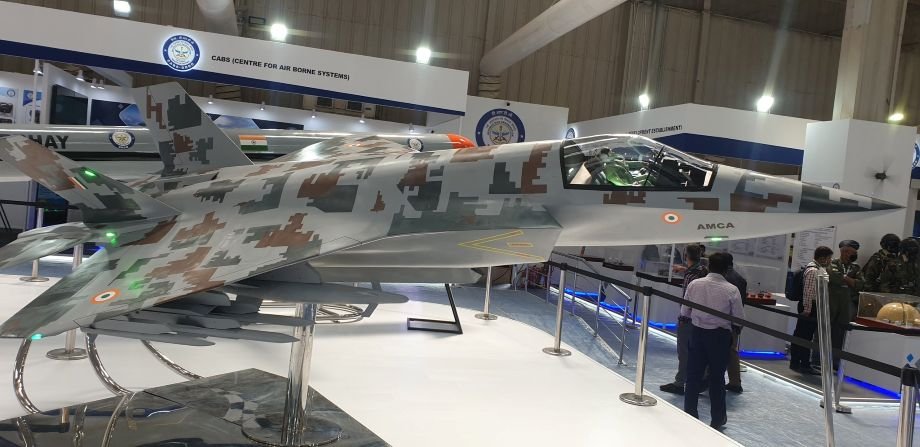
India’s ambitious effort to develop an indigenous fifth-generation fighter aircraft is approaching an important milestone, with the government expected to identify the industrial partner for the Advanced Medium Combat Aircraft (AMCA) programme within the next month. The announcement will mark a crucial development in the country’s efforts to strengthen domestic aerospace manufacturing and reduce dependence on imported combat aircraft.
Defence Secretary Rajesh Kumar Singh recently indicated that the selection process has entered an advanced stage. Speaking at the ANI National Security Summit 3.0 in New Delhi on November 16, 2026, he confirmed that proposals from all three shortlisted industry contenders had been received. Their submissions are currently being examined before the government makes its final decision.
The competition features three major Indian defence industry groups. Tata Advanced Systems Limited (TASL) has submitted its proposal independently, while Larsen & Toubro (L&T) is heading a consortium that includes Bharat Electronics Limited (BEL) and Dynamatic Technologies. The third contender is a Bharat Forge-led consortium comprising BEML and Data Patterns.
The project, estimated at approximately ₹15,000 crore, is being implemented through the Aeronautical Development Agency (ADA) under the Defence Research and Development Organisation (DRDO). The selected company or consortium will serve as the Development-cum-Production Partner, working with ADA to develop and manufacture the aircraft’s prototypes.


Under the planned development arrangement, the industry partner will manufacture five flying prototypes and one structural test specimen. ADA will continue to hold responsibility for the aircraft’s design authority and provide technical oversight throughout the programme. This approach is intended to bring India’s private defence industry more deeply into the development of advanced combat aircraft.
One notable aspect of the competition is the absence of Hindustan Aeronautics Limited (HAL) from the shortlisted bidders for this particular development contract. The selection process therefore offers a significant opportunity for private Indian companies to demonstrate their capabilities in complex military aviation projects.
The AMCA is envisioned as a twin-engine, single-seat stealth fighter belonging to the 25-tonne category. Its planned technologies include low-observable design features, internal weapons bays, advanced radar, electronic warfare capabilities, sensor fusion and sophisticated avionics. The aircraft is also being designed with supercruise capability as one of its intended performance features.
For the initial AMCA Mk1 version, the programme is expected to use General Electric F414 engines. The more advanced Mk2 configuration is planned to incorporate a higher-thrust indigenous engine developed through international cooperation. India has been examining engine-development collaboration involving the Gas Turbine Research Establishment (GTRE) and France’s Safran, alongside other proposals from the private sector.
The fighter programme is particularly important for the Indian Air Force as it seeks to modernise its combat fleet and strengthen its future operational capabilities. An indigenous fifth-generation aircraft would provide India with greater technological independence and support the development of a stronger domestic defence manufacturing base.
With all three bids submitted, attention is now focused on the government’s evaluation and forthcoming selection announcement. The decision will establish which Indian industrial group will take a leading role in transforming the AMCA design into flying prototypes, bringing India another step closer to its fifth-generation fighter ambitions.




Facebook Comments