
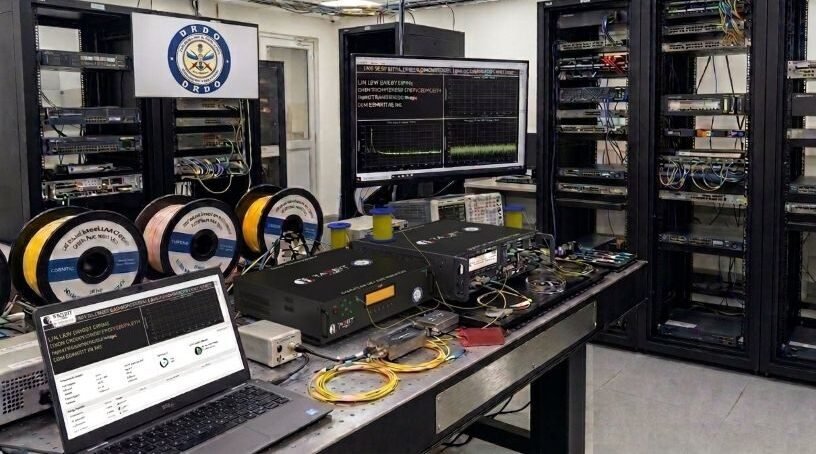
The Defence Research and Development Organisation has successfully validated quantum key distribution technology during field trials, marking a significant advancement in India’s approach to secure military communications infrastructure.
Quantum key distribution, or QKD, represents a paradigm shift in cryptographic security. Unlike conventional encryption methods that rely on mathematical complexity, QKD leverages the principles of quantum mechanics to detect any attempt at eavesdropping in real time. The technology encodes information in quantum states of photons, making interception physically impossible without altering the quantum state itself and triggering immediate detection.
DRDO’s field validation of this technology addresses a critical vulnerability in India’s defence communications architecture. Traditional encryption systems, however sophisticated, remain theoretically vulnerable to computational attack. Quantum-resistant encryption becomes essential as adversaries develop increasingly powerful computing capabilities, including potential future quantum computers that could break current cryptographic standards.
The field trials demonstrate DRDO’s capability to translate theoretical quantum physics research into operational military systems. This aligns with India’s broader indigenisation push under the Defence Acquisition Procedure and Make in India initiative, reducing reliance on foreign cryptographic solutions and establishing sovereign secure communication channels across the armed forces.


QKD has been a focus area for advanced militaries globally, with China and several European nations investing heavily in quantum communication networks. India’s validation places the country among nations pursuing domestic quantum security capabilities. Integration with existing military command and control networks presents both technical and logistical challenges that field trials are designed to address.
The technology carries particular relevance for India’s strategic communications, especially for intelligence sharing between service commands and inter-agency coordination during joint operations. Critical defence infrastructure, satellite communications, and strategic missile command networks would benefit from quantum-secured links that offer theoretical immunity to cryptanalysis.
DRDO has been building quantum research capabilities through its laboratories and collaborative programmes with Indian academic institutions. This field validation signals readiness to move from prototype to operational deployment phases. Integration timelines and the scope of initial deployment across defence networks remain part of DRDO’s ongoing technical and operational planning.
Quantum key distribution represents one pillar of India’s broader quantum technology strategy, which also encompasses quantum computing and quantum sensing applications relevant to defence reconnaissance and precision targeting systems.




Facebook Comments