
China’s Sichuan Warship Advances Naval Drone Warfare With GJ-21 Stealth Aircraft Tests
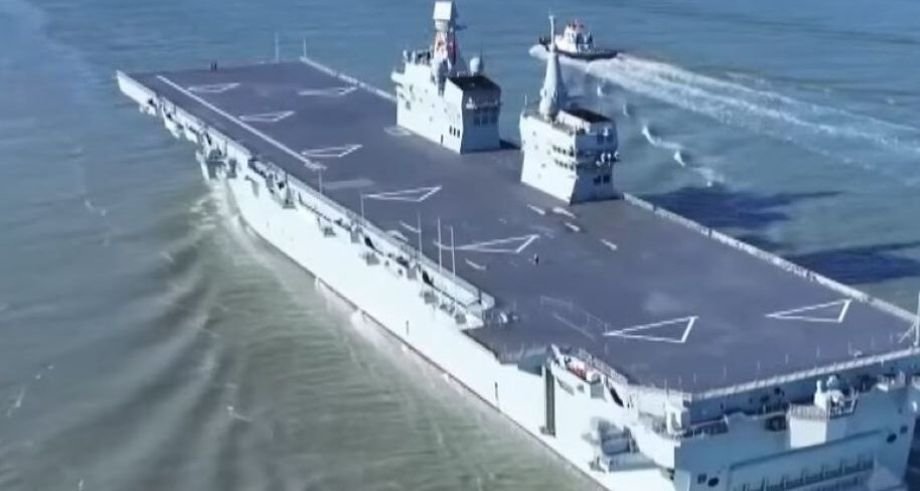
China’s naval modernisation programme has reached another significant milestone after its first Type 076 amphibious assault ship, the Sichuan, reportedly completed the first launch and recovery operations of the GJ-21 stealth unmanned combat aircraft. The development highlights China’s growing focus on integrating advanced unmanned aerial systems into its naval forces and expanding the operational capabilities of large warships.
According to China’s state news agency Xinhua and information released by the Chinese military on October 30, 2026, the GJ-21 successfully completed its maiden take-off and landing aboard the Sichuan. Chinese naval authorities described the achievement as a breakthrough in the development of amphibious assault ships, demonstrating the ability to operate fixed-wing stealth drones from large maritime combat platforms.
The Sichuan is the first vessel of China’s Type 076 class and was launched on December 27, 2024, at the Hudong-Zhonghua shipyard in Shanghai. With a full-load displacement exceeding 40,000 tonnes, the warship features a full-length flight deck and a distinctive twin-island superstructure. Its design combines traditional amphibious assault capabilities with facilities intended to support modern naval aviation operations.
One of the vessel’s most important technological features is its electromagnetic aircraft launch system and arresting equipment. Unlike conventional amphibious assault ships that primarily operate helicopters and vertical-take-off aircraft, the Type 076 is designed to support fixed-wing unmanned aircraft. The electromagnetic catapult enables aircraft to take off from the ship’s relatively short flight deck, while the arresting system assists in recovering them safely at sea.


The GJ-21 is China’s shipborne stealth reconnaissance and strike drone, developed for naval operations. It is widely associated with the land-based GJ-11 stealth unmanned combat aircraft, although the naval variant incorporates modifications required for operations from a ship. These include equipment for catapult-assisted launches and arrested landings. Its flying-wing configuration is designed to reduce radar visibility, making it suitable for missions where low observability is important.
The introduction of the GJ-21 could provide the Chinese Navy with additional options for maritime surveillance, intelligence gathering and precision-strike missions. Unmanned aircraft can potentially monitor distant sea areas, identify potential threats and support naval formations without placing pilots directly in high-risk environments. Their reusable nature could also provide operational flexibility during extended missions.
The Sichuan is not a conventional aircraft carrier but an amphibious assault ship designed to support multiple military roles. Alongside its aviation facilities, it can transport troops, military vehicles and equipment. Its well deck also allows amphibious landing craft to be deployed during operations. This combination gives the vessel the potential to support both air and sea-based missions.
China has not released detailed information about the GJ-21’s operational range, payload capacity or performance during the reported flight trials. Furthermore, the announcement confirms the successful completion of the initial shipborne operations but does not establish that the drone has entered regular operational service.
The development nevertheless represents an important step in China’s efforts to strengthen naval aviation and expand the role of unmanned systems at sea. As the Sichuan continues its testing programme, its integration of electromagnetic launch technology and stealth drones will remain an important indicator of China’s evolving maritime military capabilities.



Facebook Comments