
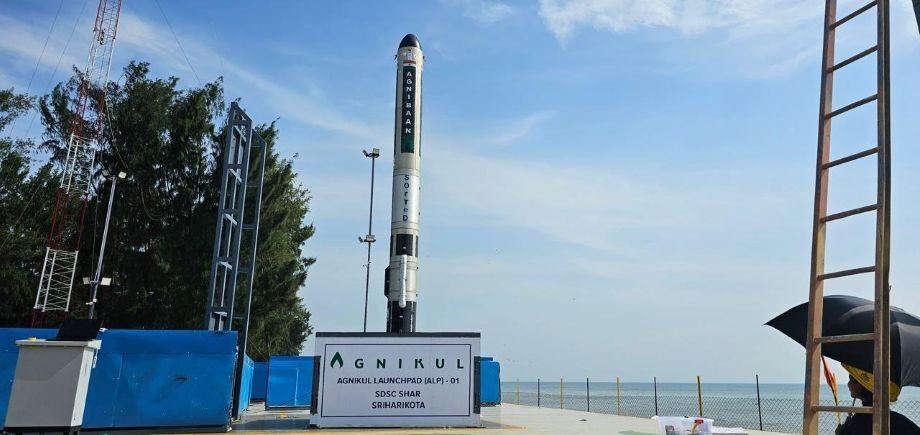
India’s private space sector has achieved another significant milestone as Chennai-based space startup Agnikul Cosmos successfully demonstrated an upgraded version of its Agnilet rocket engine. The latest test, conducted using an electric motor-driven pump-fed propulsion system, represents an important development in the company’s efforts to advance its Agnibaan orbital launch vehicle.
On November 18, 2026, Agnikul released footage showing the firing of its upgraded Agnilet engine. The demonstration highlighted the engine’s ability to operate at different power levels, with engineers gradually increasing and reducing its thrust. The test also captured distinctive diamond-shaped patterns in the exhaust plume, known as Mach diamonds, which form when high-speed exhaust gases interact with surrounding air.
One of the most important aspects of this development is the transition from a pressure-fed propulsion arrangement to an electric pump-fed system. During its first suborbital flight in May 2024, Agnikul’s Agnibaan SOrTeD rocket used a pressure-fed version of the engine. The upgraded configuration now uses electrically driven pumps to deliver propellants into the combustion chamber.
In a conventional pressure-fed system, high-pressure gas pushes fuel and oxidiser from their tanks towards the engine. A pump-fed arrangement instead uses mechanical pumps to control propellant delivery. This approach can allow lighter propellant tanks and greater flexibility in managing engine performance, making it an important technology for advanced launch vehicles.
Agnikul has maintained its distinctive manufacturing approach with the upgraded Agnilet engine. Standing approximately one metre tall, the engine is manufactured as a single-piece, fully 3D-printed structure. Its semi-cryogenic propulsion system uses liquid oxygen and kerosene-based fuel, combining advanced additive manufacturing with an electric pump-driven architecture.
The latest firing also demonstrated the engine’s throttling capability. This allows engineers to increase or decrease thrust during operation, providing greater control over propulsion performance. Such capabilities are particularly important for future launch vehicles that require precise flight control, orbital insertion and potentially reusable propulsion systems.
Another important development is the reactivation of Agnikul’s horizontal semi-cryogenic engine testing facility. According to the company, this facility will support engine testing and flight qualification activities while other development work continues in parallel. This could help the startup advance multiple stages of its launch vehicle programme more efficiently.
The upgraded engine is being developed for Agnibaan, Agnikul’s small-satellite launch vehicle designed to carry payloads into low Earth orbit. Its upcoming Mission-02 represents the company’s next major step towards demonstrating more advanced orbital launch capabilities. However, the company has not announced a confirmed launch date for the mission.
Agnikul’s progress is also receiving government support. On September 25, 2026, the Technology Development Board under the Department of Science and Technology announced a ₹200 crore financial support agreement for the company’s fully reusable Agnibaan launch vehicle programme. The initiative aims to advance indigenous reusable launch technology and improve the efficiency of future space missions.
The latest engine demonstration highlights India’s expanding private space ecosystem and the growing role of domestic startups in developing advanced propulsion technologies. With continued testing, engineering improvements and institutional support, Agnikul is working towards strengthening India’s ability to provide more flexible and cost-effective access to space.




Facebook Comments