
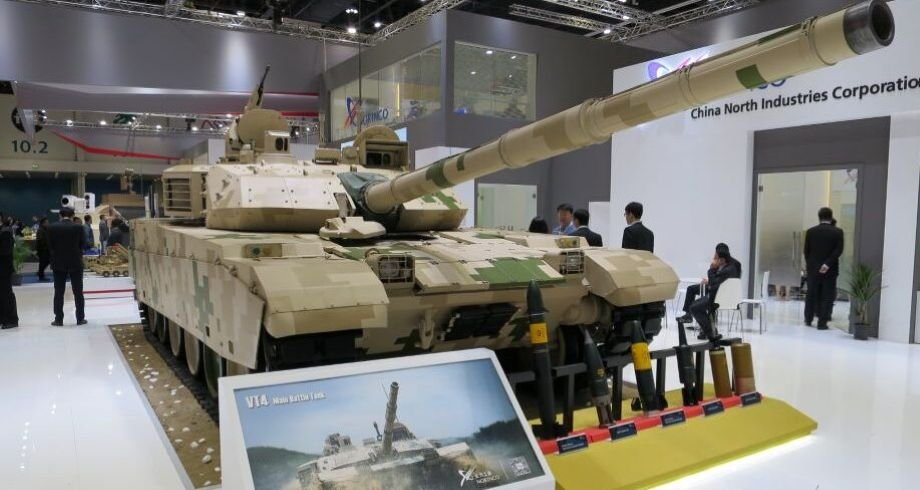
China has developed an upgraded version of its VT-4 main battle tank, introducing significant improvements in armour protection, weaponry and electronic systems. The new variant, widely identified as the VT-4B, is expected to be showcased at the China International Aviation and Aerospace Exhibition in Zhuhai from December 7 to 13, 2026. The development highlights China’s efforts to modernise its export-oriented armoured vehicles in response to changing battlefield conditions, particularly the growing threat posed by drones and precision-guided weapons.
Images of the upgraded tank circulating on social media reveal several external changes compared with the existing VT-4A configuration. One of the most noticeable improvements is the addition of thicker explosive reactive armour across the front hull and sides. The enhanced armour coverage reportedly extends further down the lower front section and protects parts of the tank’s running gear. These modifications are intended to improve survivability against incoming projectiles and other battlefield threats.
Another major development is the installation of a 30mm remotely operated weapon station on the turret. This replaces the conventional 12.7mm machine gun commonly fitted to existing VT-4 tanks. The larger-calibre weapon is expected to provide improved defensive firepower against low-flying drones, first-person-view (FPV) drones, loitering munitions and ground-based threats, including infantry and anti-tank teams. The modification reflects the increasing importance of counter-drone capabilities in modern armoured warfare.
The VT-4B also appears to incorporate an advanced active protection system, reportedly similar to China’s GL-6 configuration. The system is believed to use four phased-array radar panels positioned around the turret to detect incoming threats from different directions. Two interceptor launchers mounted near the rear of the turret could then engage approaching projectiles before they reach the vehicle. However, the precise configuration and operational performance of the system have not yet been officially confirmed.


The upgraded tank also features improvements in observation and battlefield communication equipment. Its commander’s traditional sight appears to have been replaced by a larger electro-optical and infrared (EO/IR) sensor unit, potentially improving target identification and situational awareness during both daytime and nighttime operations. New communication antennas could also support higher-bandwidth data links, allowing better information sharing between tanks and other military units.
Some of the visible technologies appear to draw inspiration from equipment developed for China’s newer Type 100 tank family and upgraded Type 99B main battle tank. Despite these additions, the VT-4B reportedly retains the fundamental design characteristics of a third-generation main battle tank rather than representing an entirely new platform.
The development is particularly relevant to Pakistan, which already operates China’s VT-4 tanks under its armoured modernisation programme. Pakistan previously signed a contract for 679 VT-4 tanks, with licensed production and assembly planned under the local designation Haider. Thailand and Nigeria are also among the countries operating the VT-4 series. However, there has been no confirmed announcement that Pakistan intends to purchase the upgraded VT-4B variant.
China’s latest tank development demonstrates how armoured vehicle manufacturers are adapting traditional main battle tanks to emerging threats, especially the growing use of unmanned aerial systems in modern conflicts. The upcoming Zhuhai exhibition will provide an opportunity to examine the upgraded platform more closely and could help China attract additional international buyers for its advanced armoured vehicle technology.

Facebook Comments