
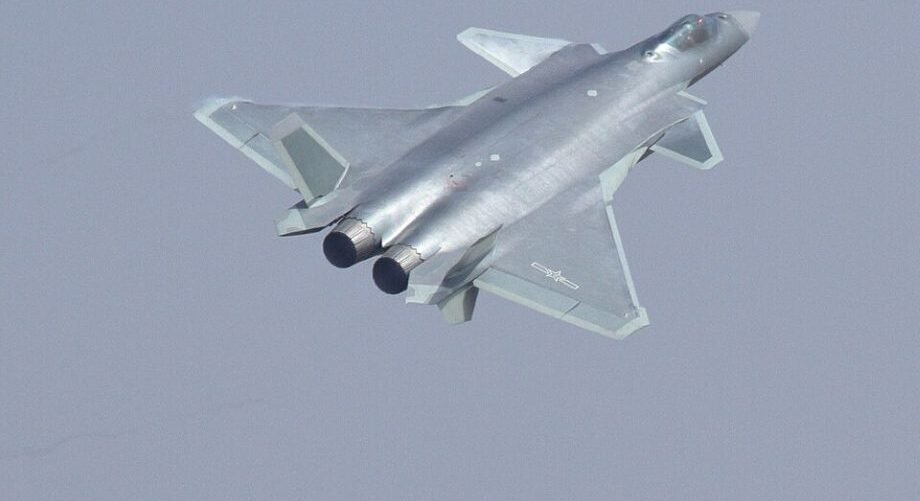
China has reportedly assembled nearly 300 military aircraft across 11 airbases in its western region as part of a major air force exercise that could become one of its largest training operations in recent years. The deployment includes advanced J-20 stealth fighters, H-6 strategic bombers and several other combat and support aircraft, highlighting the expanding operational capabilities of the People’s Liberation Army Air Force (PLAAF).
The development was identified through commercial satellite imagery analysed by the Mitchell Institute for Aerospace Studies. In a presentation released on November 11, retired US Navy intelligence officer J. Michael Dahm highlighted the extensive aircraft buildup across China’s Western Theater Command. The activity is believed to be associated with the Red Sword 2026 exercise, although Beijing has not officially confirmed the exercise’s name or its full participation details.
According to the assessment, the aircraft concentration began taking shape in mid-October. Y-20 transport aircraft and aerial refuelling tankers reportedly arrived around October 17 and 18, followed by J-10, J-16 and J-20 fighters, H-6 bombers and specialised mission aircraft. The presence of these different platforms suggests that the exercise involves more than conventional fighter training and is intended to test coordination between multiple elements of China’s air force.
Satellite imagery reportedly identified close to 300 aircraft on the parking areas of the monitored airbases, compared with a normal visible presence of approximately 80 to 100 aircraft. The number could exceed 300 when aircraft positioned inside protected shelters are considered. However, analysts have cautioned that some aircraft visible in the imagery may belong to permanently stationed units rather than participating directly in the exercise.

The composition of the deployed force is particularly significant. The J-20, China’s fifth-generation stealth fighter, represents a central element of its modern combat aviation fleet. Meanwhile, the H-6 bomber provides long-range strike capabilities, while J-10 and J-16 aircraft add conventional fighter and multirole capabilities. Y-20 transports and tanker aircraft provide essential logistical and aerial refuelling support, allowing military units to operate over greater distances and remain active for extended periods.
The exercise also highlights the importance of operational coordination. Deploying aircraft across multiple airbases requires effective communication, maintenance arrangements, fuel distribution, command networks and logistical planning. Bringing fighters, bombers, transport aircraft and specialised platforms together provides an opportunity to practise large-scale operations under a coordinated command structure.
For the United States and its regional partners, the development offers an indication of China’s growing emphasis on sustaining complex air operations. A military force’s effectiveness depends not only on the performance of individual aircraft but also on its ability to coordinate missions, maintain equipment and generate repeated sorties over an extended period.
Nevertheless, satellite imagery alone cannot establish how successfully the participating aircraft performed during the exercise. It does not confirm sortie rates, combat effectiveness or the ability to operate under electronic warfare and contested conditions. It also does not establish that the deployment was specifically designed for a Taiwan-related military scenario.
Overall, the reported buildup highlights China’s continuing efforts to strengthen its air force through large-scale training, improved logistical coordination and the integration of modern combat platforms. The suspected Red Sword 2026 exercise provides an important indication of how Beijing is preparing its air force for increasingly complex operational requirements.


Facebook Comments