
PM Modi Honoured With Uzbekistan’s Top State Award as Bilateral Partnership Gains Strategic Depth
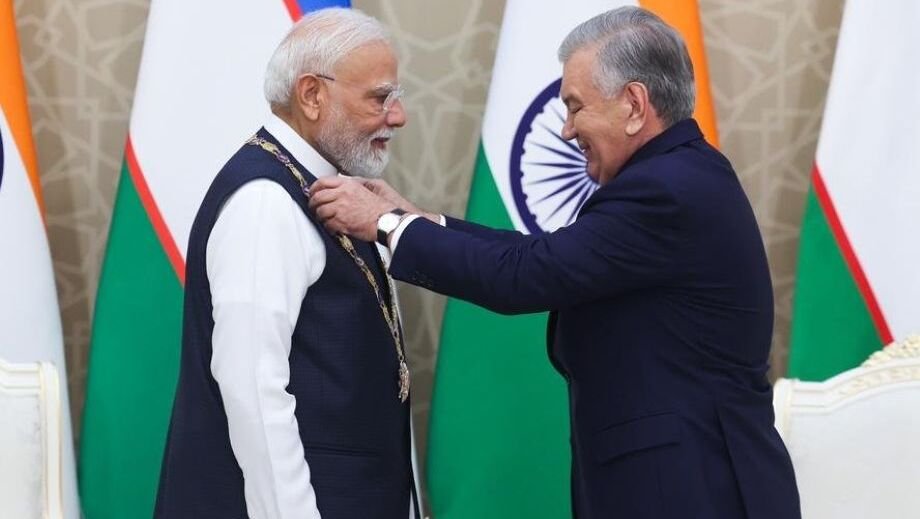
Prime Minister Narendra Modi has received Uzbekistan’s highest state distinction for foreign leaders, marking a notable moment in the growing relationship between India and the Central Asian nation. Uzbekistan President Shavkat Mirziyoyev conferred the Order of “Oliy Darajali Do’stlik” on Modi in Tashkent during the Indian Prime Minister’s state visit.
The award recognises Modi’s contribution to strengthening relations between India and Uzbekistan and comes at a time when both countries are seeking to broaden their partnership beyond traditional diplomatic and economic engagement.
While accepting the honour, Modi dedicated the recognition to the people of India and highlighted the historic links connecting the two countries. He described the award as a reflection of the friendship between India and Uzbekistan and emphasised the importance of closer cooperation between the two nations in advancing shared interests.
The visit also produced a significant diplomatic outcome, with India and Uzbekistan agreeing to elevate their relationship to a Comprehensive Strategic Partnership. The decision provides a wider framework for cooperation in areas including security, defence, investment, trade, energy, technology, education and cultural exchanges.
For New Delhi, stronger engagement with Uzbekistan is strategically important because of the country’s location at the centre of Central Asia. India has been working to expand its economic and strategic presence in the region, while Uzbekistan has been looking to deepen cooperation with India in technology, industrial development, infrastructure and other priority sectors.
Energy was among the key areas of discussion during the visit. India and Uzbekistan moved towards a long-term uranium supply arrangement, strengthening cooperation in a sector with wider strategic implications. The development is particularly relevant to India’s long-term efforts to secure reliable energy resources while expanding partnerships with resource-rich countries.
The two governments also discussed ways to increase economic and investment cooperation. Bilateral trade has been growing, while Indian and Uzbek companies have expanded their business links through joint ventures and commercial partnerships. Greater connectivity and closer institutional engagement are expected to support further growth in bilateral economic activity.
Cooperation at the regional level was another important feature of the visit. India and Uzbekistan agreed to strengthen ties between their cities and states, creating additional channels for collaboration in areas such as urban development, tourism, education and technology.
The two sides also exchanged views on developments in emerging technologies, including artificial intelligence and digitalisation, as well as areas such as scientific research and space-related cooperation. These discussions reflect the increasing importance of technology in the broader India-Uzbekistan relationship.
The strengthening of security and defence ties also remains relevant to the evolving partnership. Both countries have maintained defence and military-to-military engagement, and the upgraded strategic relationship could provide additional opportunities for cooperation in areas linked to regional security and strategic stability.
Uzbekistan has increasingly positioned India as an important partner in its efforts to expand international economic and technological cooperation. At the same time, India views stronger relations with Tashkent as an important component of its broader outreach to Central Asia and its engagement with the Global South.
The presentation of the Order of “Oliy Darajali Do’stlik” therefore carries significance beyond the ceremonial recognition of Prime Minister Modi. Coming alongside the elevation of bilateral ties to a Comprehensive Strategic Partnership, it signals a new phase in India-Uzbekistan relations, with both countries seeking deeper cooperation across strategic, economic and technological domains.
As New Delhi and Tashkent move forward with the agreements reached during the visit, the upgraded partnership is expected to create new opportunities for cooperation and reinforce India’s engagement with Central Asia.

Facebook Comments