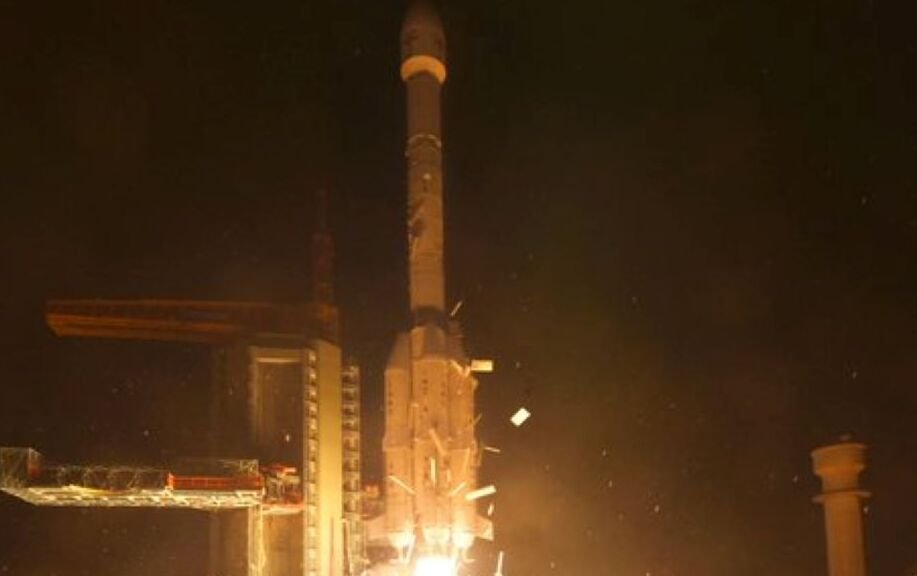
The Indian Space Research Organisation (ISRO) has achieved a significant milestone with the successful launch of the EOS-05 Earth observation satellite aboard the GSLV-F17 rocket. The mission lifted off from the Second Launch Pad at the Satish Dhawan Space Centre in Sriharikota and successfully placed the satellite into its targeted Sub-Geosynchronous Transfer Orbit.
Weighing approximately 2,367 kilograms, EOS-05 is designed to operate from a high-altitude geosynchronous orbit, giving India an advanced capability for persistent Earth observation. The mission also demonstrates the increasing maturity of India’s indigenous launch vehicle technology, with the three-stage GSLV-F17 powered by an Indian-developed cryogenic upper stage.
EOS-05, also associated with the GISAT-1A designation, is intended to strengthen India’s ability to continuously monitor the Indian subcontinent. Its geosynchronous positioning is a key feature of the satellite. Unlike conventional Earth observation satellites in low Earth orbit, which periodically pass over a particular location, EOS-05 is designed to remain positioned over the same broad region from an altitude of nearly 36,000 kilometres above the equator.
This orbital capability can provide much more frequent observations of areas of interest. According to the reference report, EOS-05 can support imaging at intervals of around 30 minutes, with targeted areas potentially being revisited in as little as five minutes. Such rapid observation can be particularly valuable when monitoring events that develop quickly.
The satellite is expected to have important applications in disaster management and environmental monitoring. Frequent imagery can help authorities track cyclones, floods, forest fires and landslides, providing timely information that can support emergency response and assessment efforts.
Beyond civilian applications, EOS-05 also has strategic significance. Persistent Earth observation from a geosynchronous orbit can contribute to situational awareness, intelligence, surveillance and reconnaissance (ISR) requirements. The ability to repeatedly observe selected areas can provide useful information for monitoring changes in terrain, infrastructure and other strategically important locations.
The satellite’s capabilities are not limited to defence and security applications. Data from EOS-05 can also support agricultural assessments, water-resource monitoring, urban planning and broader environmental studies. This makes the mission an important addition to India’s Earth observation infrastructure.
The successful GSLV-F17 mission further highlights India’s progress in developing reliable heavy-lift launch capabilities and advanced satellite technologies. The 51.7-metre-tall launch vehicle carried the spacecraft inside a four-metre-diameter composite payload fairing during its ascent, demonstrating the engineering complexity involved in delivering a large Earth observation satellite into its intended orbit.
The mission also reflects the growing contribution of India’s wider space ecosystem, including private-sector companies and industrial partners involved in supplying components and technologies for the country’s launch programmes. As India continues to expand its space-based capabilities, missions such as EOS-05 are expected to play an increasingly important role in both civilian applications and national security.
With the successful deployment of EOS-05, ISRO has added another powerful asset to India’s growing satellite fleet. Its ability to provide frequent observations from geosynchronous orbit could strengthen India’s capacity to monitor its territory, respond to natural disasters and improve strategic situational awareness from space.
-

-

-

-