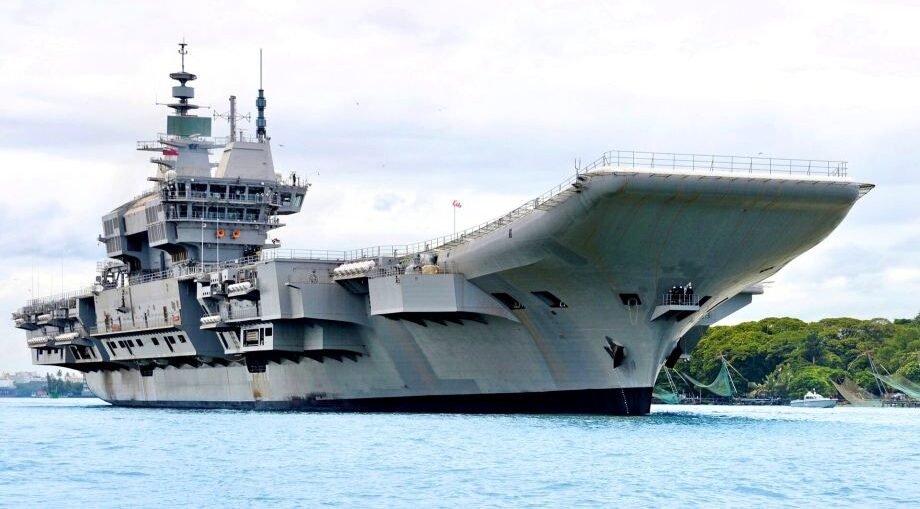
India’s preparations to deploy Rafale Marine fighter aircraft from its indigenous aircraft carrier INS Vikrant have entered an important phase, with the Indian Navy introducing changes to the ship’s flight deck. One of the latest modifications is a triangular landing reference marking inspired by the arrangement used on France’s Charles de Gaulle aircraft carrier. The addition is intended to improve visual guidance for pilots during carrier landing operations.
Unlike conventional airfield landings, recovering a fighter aircraft aboard a carrier requires precise coordination between the pilot and the ship’s landing facilities. The available landing area is limited, while the carrier’s movement at sea makes the approach more demanding. The newly introduced triangular marking provides pilots with an additional visual reference to help assess their alignment during the final approach. It supplements the existing optical landing guidance equipment rather than replacing it.
The modification follows the successful maiden landing of a Rafale Marine fighter aboard INS Vikrant on October 29, 2026. The aircraft completed the landing on its first attempt, representing a significant achievement in the process of validating the French-designed fighter for Indian carrier operations. The trials are part of the broader effort to establish the aircraft’s compatibility with the Navy’s indigenous carrier.
However, integrating the Rafale Marine presents technical differences compared with its operations from French aircraft carriers. France’s Charles de Gaulle uses a Catapult Assisted Take-Off But Arrested Recovery (CATOBAR) system, which launches aircraft using catapults. INS Vikrant, in contrast, operates a Short Take-Off But Arrested Recovery (STOBAR) arrangement, where fighters use a ski-jump ramp for take-off and arresting wires for landing.
The aircraft’s physical dimensions also require attention. The Rafale Marine has a wingspan of approximately 10.9 metres and does not have folding wings. INS Vikrant’s aircraft elevators are approximately 10 metres wide and were originally designed around aircraft such as the MiG-29K, which has folding wings. This creates a requirement for modifications to ensure the larger French fighter can be moved safely between the hangar and flight deck.
India signed a procurement agreement with France in April 2025 for 26 Rafale Marine aircraft worth approximately Rs 63,000 crore. The contract covers 22 single-seat fighters and four twin-seat trainers, alongside weapons, simulators, pilot training and logistical support. Deliveries are expected to begin towards the end of 2028.
The induction of Rafale Marine fighters is expected to strengthen the Indian Navy’s ability to conduct maritime air defence, strike missions and reconnaissance operations. Their deployment from INS Vikrant will also add a modern combat aviation capability to India’s expanding carrier fleet.
The latest flight deck modification, together with the ongoing integration trials, reflects the technical preparations required to operate advanced naval fighters from an Indian-built aircraft carrier. Further testing and infrastructure work will be necessary before the Rafale Marine fleet becomes fully operational with the Indian Navy.
-

-
-

-