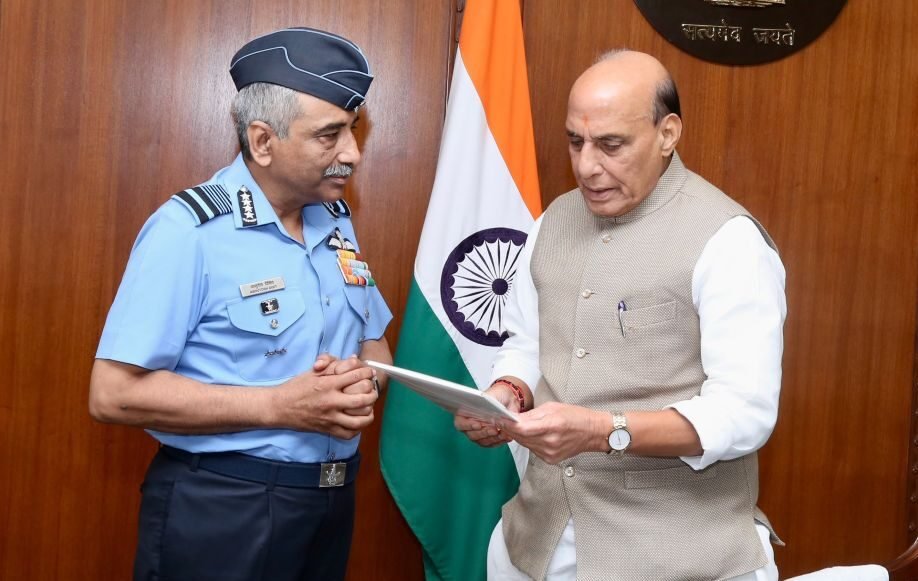
Defence Minister Rajnath Singh met Air Chief Marshal Ashutosh Dixit in New Delhi, extending his best wishes as the senior officer begins his tenure as the head of the Indian Air Force (IAF). The interaction comes at an important time for India’s air power, with the service pursuing major modernisation programmes and strengthening its operational capabilities amid an evolving regional security environment.
Following the meeting, Rajnath Singh shared his message on social media, describing Air Chief Marshal Dixit as an accomplished air warrior with strong leadership qualities. He expressed confidence in the new Air Chief’s abilities and wished him success in carrying forward the responsibilities of leading one of India’s most important defence services.
Air Chief Marshal Ashutosh Dixit assumed charge as the 29th Chief of the Air Staff on October 31, 2026, succeeding Air Chief Marshal AP Singh. His appointment comes as the Indian Air Force faces several important priorities, including improving combat preparedness, expanding indigenous aircraft capabilities and addressing the long-standing requirement to strengthen its fighter squadron numbers.
With extensive experience in fighter operations, flight testing and senior command appointments, Dixit brings a broad understanding of the IAF’s operational and technological requirements. He was commissioned into the Indian Air Force’s Fighter Stream on December 6, 1986, and has served in several significant positions during his military career. His professional experience includes flying different fighter aircraft, overseeing operational units and contributing to aircraft development and modernisation initiatives.
The new Air Chief’s responsibilities will extend beyond maintaining day-to-day operational readiness. The IAF is working towards a major technological transition involving advanced combat aircraft, precision weapons, unmanned systems, improved surveillance and integrated air defence capabilities. These developments are becoming increasingly important as modern conflicts demonstrate the growing role of drones, electronic warfare, networked operations and long-range precision strikes.
Indigenous defence production is another major area of focus. Programmes such as the Light Combat Aircraft Tejas Mk1A, Tejas Mk2 and Advanced Medium Combat Aircraft (AMCA) are central to India’s ambition to develop stronger domestic aerospace capabilities. The IAF’s continued involvement in these programmes will be important for aligning future aircraft requirements with operational needs.
Improving coordination among the Indian Army, Indian Navy and Indian Air Force will also remain essential for joint military operations. The increasing importance of integrated theatre-level planning, shared intelligence and coordinated use of air assets is shaping the future direction of India’s defence strategy.
Air Chief Marshal Dixit’s experience in operational command and aviation technology development provides an important foundation as the IAF addresses these challenges. His tenure will be closely associated with efforts to maintain the service’s operational edge while supporting India’s broader objective of becoming more self-reliant in defence manufacturing.
Rajnath Singh’s meeting with the new Air Chief reflects the Defence Ministry’s engagement with the Indian Air Force’s incoming leadership. As the service moves forward with its modernisation agenda, maintaining combat readiness, strengthening domestic aerospace development and preparing for emerging threats will remain central to its mission.
-

-
-
-