
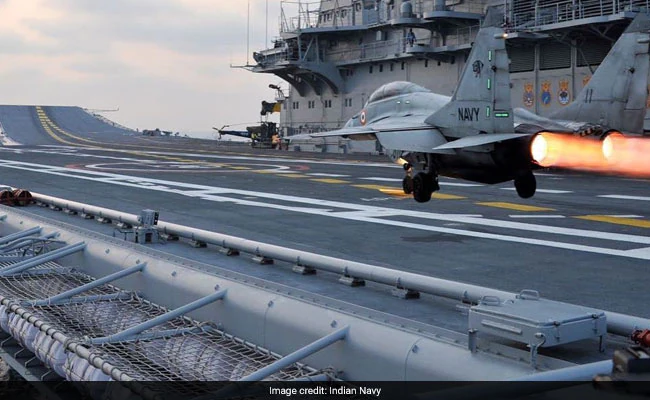
The Indian Navy has initiated a requirement for indigenously developed 80-millimetre rockets to equip its MiG-29K carrier-based fighter jets, marking another step in the service’s broader push to reduce dependence on imported air-to-surface munitions.
The move reflects New Delhi’s accelerating focus on homegrown weapon systems across its three services. For the Navy, the 80-mm rocket programme would fill a critical gap in the MiG-29K’s current loadout, enabling the aircraft to engage a wider range of targets during maritime operations from INS Vikramaditya and future carriers.
The MiG-29K, which entered Indian Navy service in 2009 following induction trials aboard Vikramaditya, currently relies on Russian-origin air-to-surface rockets and guided munitions. The aircraft serves as the primary air combat and strike platform for India’s carrier aviation fleet, tasked with fleet air defence, anti-ship strikes, and strike missions across the Indian Ocean region.
An 80-mm rocket programme would complement existing indigenous efforts in the air-launched munitions domain. DRDO laboratories, particularly Pune-based Armament Research and Development Establishment and Bengaluru’s Defence Research and Development Laboratory, have been developing various classes of guided and unguided rockets for tactical air operations.


The requirement aligns with India’s broader Make in India strategy for defence manufacturing. Over the past decade, the Navy has progressively shifted towards indigenous or jointly developed weapons platforms, from the Brahmos cruise missile to the under-development Nirbhay cruise missile variants. Rocket systems for fighter jets fall within this spectrum.
Development of a purpose-built 80-mm rocket for naval aviation would also reduce foreign exchange outflows on recurring ammunition purchases. The MiG-29K fleet undertakes regular operational sorties, exercises, and carrier qualifications, generating sustained demand for unguided and guided rocket munitions.
Integration of indigenous rockets onto the MiG-29K airframe requires validation of launch dynamics, handling characteristics, and operational procedures. This process typically involves ground testing, followed by controlled flight trials and eventual carrier qualification sorties.
The programme’s success would enhance the Navy’s operational flexibility during contingency operations and reduce lead times in procurement cycles currently dependent on foreign vendors. It also strengthens India’s position in developing a complete indigenous air-launched munitions portfolio across fixed-wing and rotary-wing maritime platforms.


Facebook Comments