
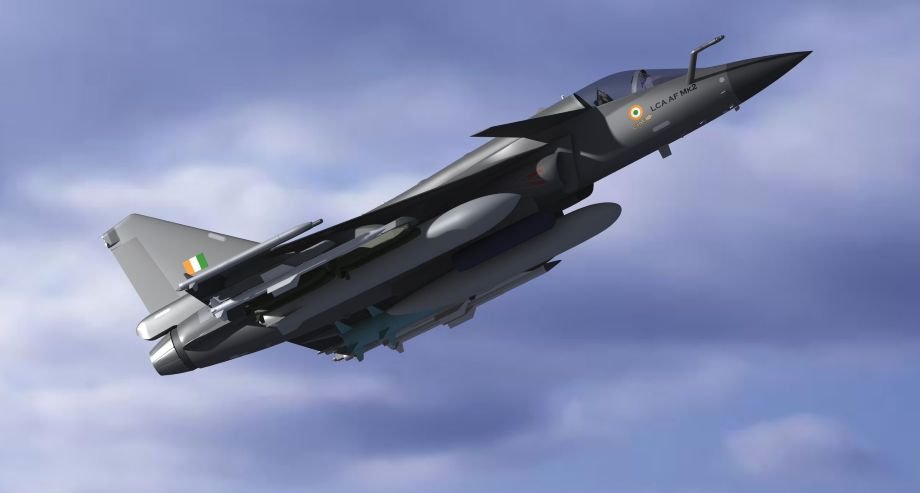
India’s indigenous fighter aircraft development effort is approaching two important milestones, with the Tejas Mk2 expected to undertake its maiden flight by September 2027, followed by the Advanced Medium Combat Aircraft (AMCA) prototype in September 2028. The timelines provide a clearer indication of when the two aircraft are expected to enter their respective flight-test phases as India expands its domestic capability in fighter aircraft design and development.
The Tejas Mk2, also referred to as the Medium Weight Fighter, is being developed by the Aeronautical Development Agency (ADA) in association with Hindustan Aeronautics Limited (HAL). Conceived as a larger and more capable aircraft than the Tejas Mk1A, the fighter is being designed to offer greater range, payload capacity and multirole capability. The programme is aimed at strengthening the medium-weight segment of the Indian Air Force’s future combat fleet.
Powered by the General Electric F414 engine, the Tejas Mk2 is expected to feature modern avionics, an active electronically scanned array radar, infrared search and track capability and advanced electronic warfare systems. Its larger airframe and aerodynamic configuration are intended to provide additional fuel and weapons capacity while supporting a wider range of operational roles.
Work on the first prototype has been progressing toward the aircraft-level testing phase. The completion of structural and assembly activities will be followed by ground checks and system integration before the aircraft begins its flight-test programme. The September 2027 target therefore represents a key development milestone rather than an operational induction date.
The aircraft is also expected to contribute to the Indian Air Force’s longer-term fleet modernisation. As older fighter platforms gradually reach the later stages of their service lives, the Tejas Mk2 is being developed as part of India’s effort to build a stronger indigenous replacement pipeline for medium-weight combat aircraft.
At the same time, India is advancing the AMCA, which represents a more technologically ambitious stage of the country’s fighter aircraft development programme. The twin-engine aircraft is being designed as a fifth-generation combat platform with stealth-oriented features, internal weapons carriage, advanced sensors, electronic warfare capabilities and integrated avionics. ADA is leading the aircraft’s design and development.
The AMCA programme has also adopted a greater role for private industry. Under the government-approved execution model, an Indian private-sector industry partner will work with ADA in the development and production of prototypes. This approach is intended to expand industrial participation and create additional capacity for advanced fighter aircraft manufacturing in the country.
The development of dedicated testing infrastructure is another part of the programme. A new Aircraft Integration and Flight Testing Centre at Puttaparthi in Andhra Pradesh is being established to support integration, testing, validation and certification activities for indigenous aircraft programmes. Such infrastructure is expected to support the increasingly complex testing requirements associated with next-generation combat aircraft.
The planned first flights of the Tejas Mk2 and AMCA will be followed by extensive testing and certification before either aircraft can enter operational service. Their progress will depend on successful system integration, ground trials, flight testing, weapons integration and certification. If the current timelines are achieved, the two programmes will mark important stages in India’s continuing effort to strengthen indigenous fighter aircraft development and manufacturing capabilities.



Facebook Comments