
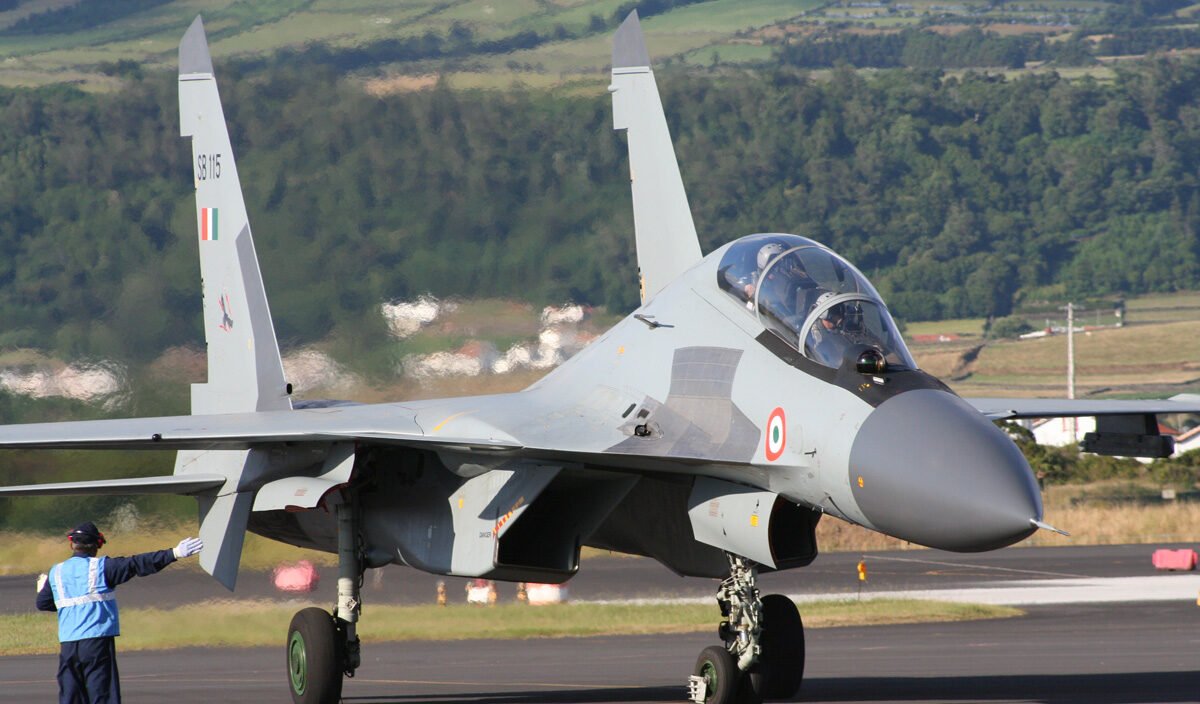
India’s Su-30MKI fighter fleet is set to receive an advanced active electronically scanned array radar, marking a significant step in modernising the air force’s premier air-superiority platform with indigenous and foreign technology integration.
The radar upgrade will feature the largest AESA system fitted to the aircraft, paired with a redesigned radome to accommodate the enhanced antenna architecture. This development represents a continuation of India’s effort to keep its Su-30MKI fleet at the cutting edge of fighter technology.
The Su-30MKI has served as the backbone of the Indian Air Force’s combat capability since the late 1990s. Jointly developed by Russia’s Sukhoi and India’s Hindustan Aeronautics Limited, the platform has undergone multiple upgrade cycles to extend its operational relevance and combat effectiveness across varied threat scenarios.
Earlier variants of the Su-30MKI were equipped with the Bars phased-array radar, a mechanically scanned system offering solid detection and tracking capability. The transition to AESA technology provides substantial advantages in terms of detection range, multi-target engagement capacity, faster beam scanning, and improved electronic warfare resilience. AESA systems deliver faster refresh rates and greater flexibility in radar modes, enabling simultaneous air-to-air and air-to-ground operations.

The radome redesign is a critical engineering undertaking. The radome is the nose cone that houses and protects the antenna while maintaining aerodynamic integrity. A larger AESA antenna requires a physically larger radome, which demands careful structural analysis to ensure the aircraft maintains its thermal, aerodynamic, and structural properties during high-speed operations and combat manoeuvres.
This upgrade aligns with India’s broader strategy of enhancing the operational lifespan of existing platforms through incremental technology infusion rather than wholesale fleet replacement. The Su-30MKI fleet, numbering over 270 aircraft, represents a massive capital asset, and modernising it through radar and avionics upgrades is cost-effective compared to procurement of entirely new fighter types.
The AESA upgrade also reflects India’s deepening indigenous and international defence partnerships. While AESA technology development has been supported by Russia in previous collaborations, such modernisation efforts increasingly involve technology sourcing and system integration expertise from multiple partners to ensure operational sovereignty and customisation for Indian Air Force requirements.
The timeline and rollout schedule for this upgrade across the operational fleet will determine when the Su-30MKI gains full AESA capability. Phased implementation across squadrons ensures continuity of operational deployments while selected aircraft undergo modification and flight testing of the new radar system.


Facebook Comments