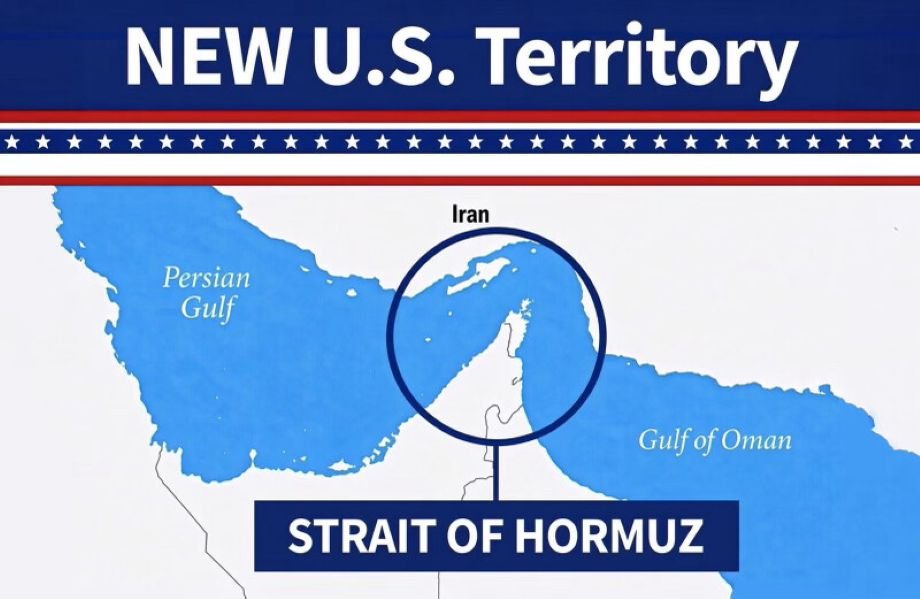
U.S. President Donald Trump has once again escalated tensions with Iran by describing the strategically important Strait of Hormuz as “NEW U.S. Territory.” Trump shared a map on social media marking the waterway with the new label, reinforcing his repeated claims that the United States now has control over the vital maritime passage.
The latest statement comes amid an ongoing confrontation between Washington and Tehran, with the Strait of Hormuz emerging as one of the most sensitive flashpoints in the conflict. Trump has previously said that the United States has control of the strait and has insisted that Washington intends to maintain its influence over shipping through the waterway.
Iran has strongly rejected Trump’s claims. Iranian officials have described the U.S. position as unacceptable and continue to insist that the country has the authority to regulate maritime traffic through the strategic passage. Iranian officials have also linked the reopening of the waterway to changes in U.S. policies, including the removal of the naval blockade and economic pressure on Tehran.
The Strait of Hormuz is one of the world’s most important energy routes, connecting the Persian Gulf with the Gulf of Oman and the wider Arabian Sea. A significant share of global oil and gas shipments traditionally passes through the waterway, meaning prolonged disruption could have consequences for energy prices, international trade and global supply chains.
Shipping activity through the strait has already been severely affected by the confrontation. Iran has continued to use control over the waterway as a major source of leverage, while the United States has maintained a naval blockade and claimed that its forces have significant control over maritime movement.
Trump’s latest “NEW U.S. Territory” label has therefore added another layer to the dispute. Although the statement has been presented as part of his broader campaign to assert American control over the waterway, Iran has dismissed the claim and warned that Washington cannot unilaterally determine the status of the Strait of Hormuz.
The confrontation is also taking place alongside renewed U.S. economic pressure on Iran. Washington is preparing tougher sanctions against Tehran, while Iranian officials have warned that additional sanctions could further escalate the crisis. Iran’s Foreign Minister Abbas Araghchi has rejected the U.S. approach and called for diplomacy, while other Iranian officials have warned that continued pressure could trigger a stronger response.
With diplomatic efforts still facing major obstacles, the Strait of Hormuz remains at the centre of the wider U.S.-Iran standoff. Trump’s latest territorial claim highlights Washington’s determination to maintain control over the strategic waterway, while Tehran continues to oppose any attempt to establish American authority over it. The dispute could have wider implications for maritime security, global energy markets and the geopolitical balance across the Middle East.
-

-
-
-