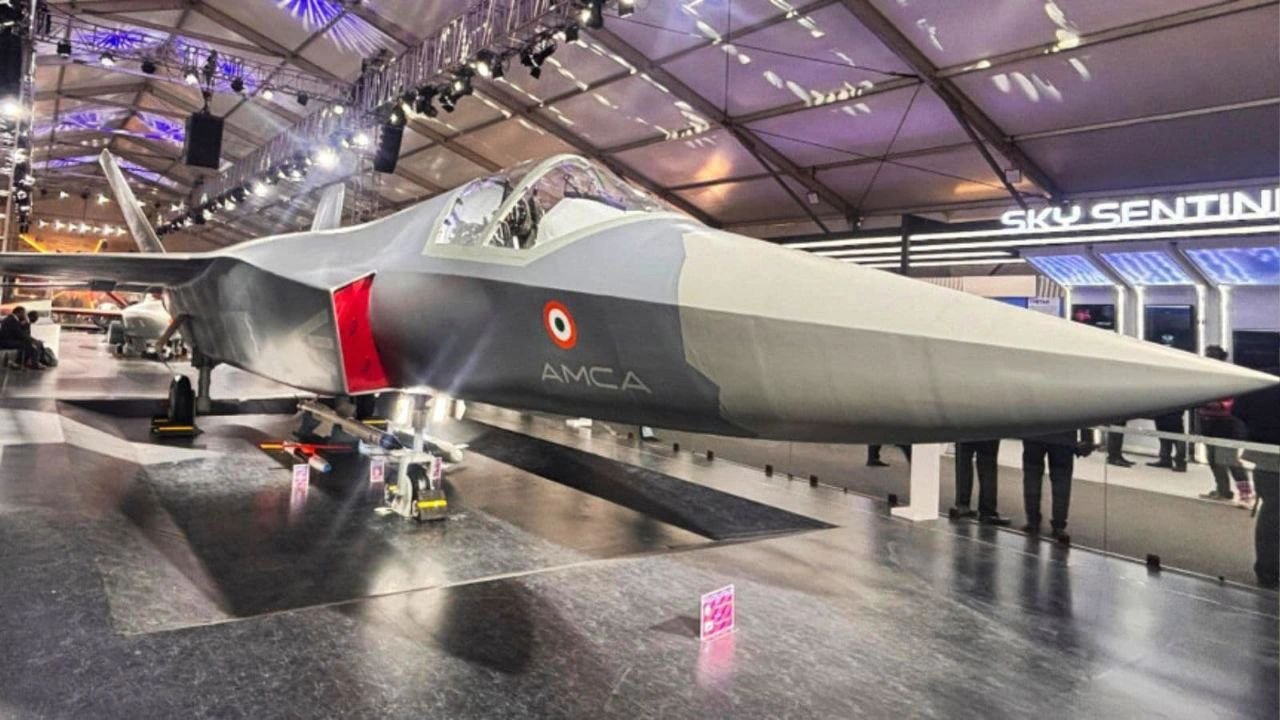
Three private defence manufacturers have been shortlisted to compete in the development of the Advanced Medium Combat Aircraft (AMCA), India’s indigenous fifth-generation stealth fighter jet programme, according to NDTV. The move marks a significant shift toward privatisation in India’s most ambitious combat aircraft initiative, breaking from the traditional model where state-owned Hindustan Aeronautics Limited (HAL) has led all fighter development programmes.
The AMCA programme, led by the Defence Research and Development Organisation (DRDO), is designed to replace the Tejas Light Combat Aircraft as India’s primary air-superiority platform by the 2030s. The aircraft is envisioned as a twin-engine, medium-weight stealth fighter with advanced avionics, sensor fusion, and network-centric warfare capabilities comparable to global fifth-generation platforms.
Private sector participation in the AMCA project reflects the government’s broader Make in India and Atmanirbhar Bharat objectives in defence manufacturing. The inclusion of private players is intended to accelerate development timelines, leverage specialised expertise in systems integration and subsystems manufacturing, and reduce dependency on government establishments for critical defence platforms.
The AMCA programme has been in conceptual and preliminary design phases since the early 2000s. Initial timelines projected a technology demonstrator by the late 2020s, with operational induction targeted for 2035 or later. The aircraft is expected to feature internal weapons bays for reduced radar cross-section, fly-by-wire flight control systems, and an indigenously developed aero-engine currently under development by DRDO’s Gas Turbine Research Establishment (GTRE).
The competitive selection of private contractors represents a departure from HAL’s exclusive role in Tejas development and indicates growing confidence in India’s private defence industrial base. Companies such as Tata Advanced Systems, Bharat Electronics Limited (BEL), and others have invested in aerospace capabilities and manufacturing infrastructure over the past decade, positioning themselves as credible partners for large-scale defence platform development.
This privatisation approach is consistent with recent policy changes in India’s defence procurement, including expanded Foreign Direct Investment limits in defence manufacturing and incentives for indigenous design and development. However, DRDO is expected to retain primary responsibility for core technology development, aerodynamic design validation, and mission system architecture to ensure operational requirements and security parameters are met.
The AMCA programme remains central to India’s strategy to secure air superiority against peer competitors in the Indo-Pacific region and reduce the technological gap with advanced air forces operating fifth-generation fighters. With induction timelines extending into the 2030s, the aircraft will coexist with Tejas Mark-II variants and HAL’s twin-engine fighter (HLFT-42) project during India’s transition to a modernised combat air fleet.
-

-
-

-