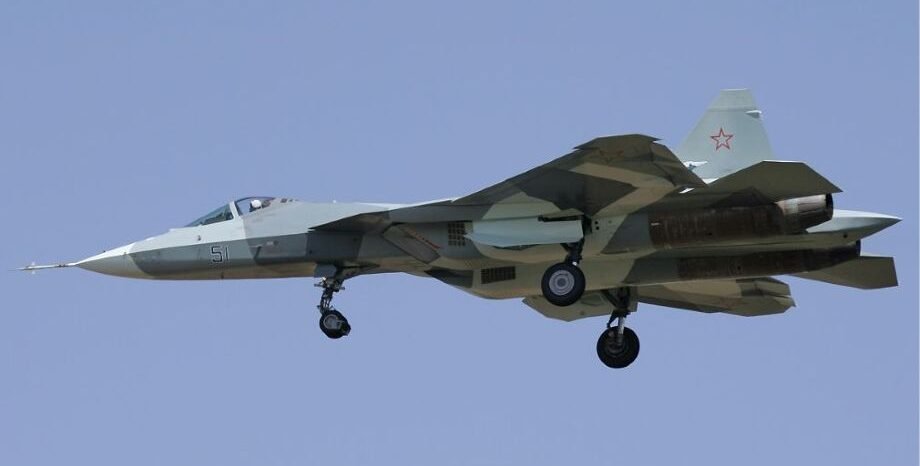
Russian President Vladimir Putin has renewed Moscow’s push to position the Su-57 fifth-generation stealth fighter as a potential option for India, with Russia reportedly highlighting an expanded package that includes advanced missiles, technology transfer and opportunities for local production.
The latest proposal comes as India continues to strengthen its combat aviation capabilities while pursuing the indigenous Advanced Medium Combat Aircraft (AMCA) programme. Russia has been attempting to make the Su-57 offer more attractive by presenting it as a broader defence-industrial partnership rather than simply an aircraft sale.
According to recent reports, the Russian offer includes advanced weapons that could significantly expand the Su-57’s strike and air-combat capabilities. Among the systems highlighted are the Kh-69 stealth cruise missile and the R-37M long-range air-to-air missile. Russia has also promoted advanced and hypersonic weapon capabilities as part of the wider Su-57 package.
The Kh-69 is designed to provide a long-range stand-off strike capability, allowing an aircraft to attack targets from significant distances. The R-37M, meanwhile, is intended for long-range engagement of airborne targets and could provide the Su-57 with an extended-range air-to-air capability.
Beyond weapons, technology transfer remains a central part of Moscow’s pitch. Russia has previously offered India opportunities for joint production of the Su-57 and greater involvement in the aircraft’s manufacturing and technological ecosystem. Putin had earlier stated that Moscow was prepared to cooperate with India without limitations on the Su-57 programme.
The proposal is particularly significant because India has been seeking greater domestic participation in defence manufacturing. A potential Su-57 arrangement involving local production and technology sharing could provide Indian industry with additional experience in advanced fighter manufacturing, although any such agreement would require detailed evaluation of costs, technology access and long-term support requirements.
Russia has also sought to link its offer with India’s future aerospace ambitions. Moscow has indicated its willingness to cooperate on advanced combat-aircraft technologies, potentially giving India another avenue for technological collaboration while the country develops the AMCA.
However, there is currently no confirmed Indian decision to acquire the Su-57. Recent reports indicate that New Delhi is focusing on upgrading its existing Su-30MKI fleet, acquiring additional Rafale fighters and advancing the indigenous AMCA programme instead of immediately committing to a new Russian fifth-generation fighter.
This makes Russia’s latest proposal more of a strategic pitch than a confirmed procurement programme. Moscow is attempting to address some of the concerns that previously affected India’s participation in the earlier Russia-India Fifth Generation Fighter Aircraft programme by offering deeper industrial cooperation and greater technology access.
For India, the decision will ultimately depend on the Su-57’s operational capabilities, stealth performance, weapons integration, production arrangements, technology transfer, cost and compatibility with the country’s long-term fighter strategy.
Russia’s renewed campaign nevertheless highlights Moscow’s continued interest in maintaining a major role in India’s military aviation ecosystem. While the Su-57 remains a significant fifth-generation fighter option, India’s current emphasis on indigenous development means that any future decision on the Russian aircraft will have to be weighed carefully against the country’s AMCA ambitions and broader air-power modernisation plans.
-
-
-
-