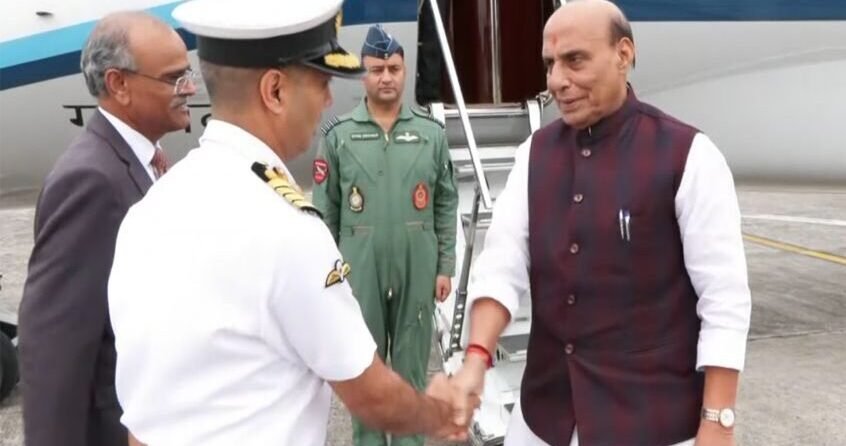
Defence Minister Rajnath Singh has departed for New Delhi after completing his official visit to Cebu, Philippines, where he participated in the 13th ASEAN Defence Ministers’ Meeting-Plus (ADMM-Plus). His visit focused on strengthening India’s defence partnerships with Southeast Asian nations and advancing cooperation on regional and international security challenges.
Before leaving the Philippines, Singh visited a Gurudwara and a Hindu temple in Cebu, where he offered prayers and interacted with members of the Indian community. His engagements marked the conclusion of a significant diplomatic visit aimed at expanding India’s strategic presence and cooperation across the Indo-Pacific region.
During the ADMM-Plus discussions, Singh highlighted India’s commitment to building stronger defence relationships with ASEAN member countries. He emphasised that lasting regional stability requires collective efforts, mutual trust and closer cooperation among participating nations. The meeting provided an important platform for discussing emerging security challenges and identifying opportunities for greater collaboration.
One of the key announcements during his address was India’s proposal to establish an India-ASEAN Youth Bridge. The proposed initiative aims to strengthen connections between young people in India and ASEAN countries through digital innovation, capacity building and people-to-people engagement. Singh highlighted the shared demographic potential of India and Southeast Asia, describing young people as an important foundation for the region’s future development and prosperity.
Counter-terrorism cooperation was another major focus of India’s participation. Singh reiterated the need for a united international response against terrorism, particularly addressing organisations and networks that provide financial, logistical or other forms of support to terrorist groups. Referring to India’s experience in tackling cross-border security threats, he stressed that effective counter-terrorism strategies must be based on practical experience and coordinated international action. He also cited Operation Sindoor while highlighting India’s approach towards addressing terrorist infrastructure.
On the sidelines of the meeting, Singh held discussions with defence leaders from several important partner nations, including the United States, Japan, Australia, the Philippines, South Korea and Singapore. These engagements provided opportunities to review existing defence partnerships and discuss further cooperation in areas of regional security and military engagement.
His discussions with US Secretary of War Pete Hegseth were particularly significant, with both sides reviewing progress under the 10-year India-US Defence Framework. The discussions covered operational readiness, military technology cooperation, information sharing and defence industrial integration. Both countries also reiterated their commitment to combating terrorism and maintaining a secure Indo-Pacific region.
The ADMM-Plus remains an important multilateral platform connecting ASEAN’s 11 member states with eight dialogue partners, including India, the United States, China, Russia, Japan, South Korea, Australia and New Zealand. It provides a framework for dialogue and practical cooperation on defence and security matters.
India’s participation in the Cebu meeting reflects its continued focus on the Act East Policy and its broader Indo-Pacific vision. By strengthening defence relationships, encouraging regional counter-terrorism cooperation and investing in youth engagement, New Delhi is seeking to contribute to a more connected and stable regional security environment.
With the conclusion of his Philippines visit, Rajnath Singh’s return to New Delhi marks the end of another round of India’s high-level defence diplomacy in Southeast Asia. The discussions and proposed initiatives at the 13th ADMM-Plus could provide further opportunities to deepen India’s strategic engagement with ASEAN partners in the coming years.
-

-

-

-