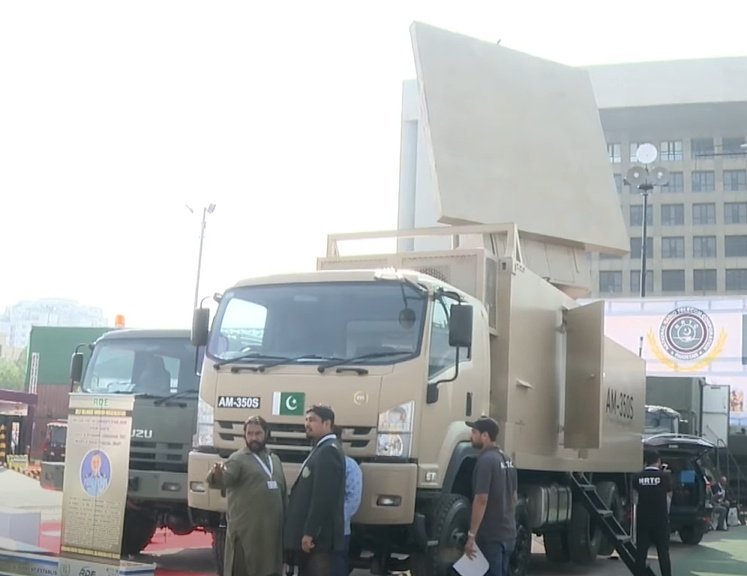
Pakistan has taken a significant step in strengthening its air defence infrastructure by deploying two advanced radar systems-the AM-350S long-range radar and the Machaan tactical AESA radar. These systems are designed to enhance the country’s ability to detect, track, and respond to a wide range of aerial threats, including fighter jets, drones, and cruise missiles.
The AM-350S is believed to be a high-performance 3D Active Electronically Scanned Array (AESA) radar capable of monitoring airspace over long distances. Its advanced tracking capabilities allow it to simultaneously monitor multiple targets, providing early warning and improving situational awareness. On the other hand, the Machaan radar is a more mobile and flexible system intended for short- to medium-range operations, ensuring coverage at lower altitudes and in tactical environments.
A key aspect of this development is the integration of these radar systems with a China-supported satellite communication network. This connectivity enables real-time data exchange between different defence platforms, creating a more coordinated and responsive air defence ecosystem. Such integration is crucial in modern warfare, where speed, accuracy, and information dominance play a decisive role.
Defence analysts believe that this move reflects Pakistan’s shift toward a network-centric warfare strategy. Instead of relying on standalone systems, the country is focusing on building a connected defence grid that can quickly identify and neutralize threats. This approach also improves resilience against electronic warfare tactics, making the overall system more robust and reliable.
The deployment is expected to have broader implications for regional security dynamics. As countries in South Asia continue to modernize their military capabilities, advancements in radar and surveillance technology are becoming increasingly important. Enhanced detection systems can potentially alter operational planning and airspace control strategies in the region.
Overall, the induction of these advanced AESA radar systems highlights Pakistan’s ongoing efforts to modernize its defence capabilities and adapt to evolving technological challenges in the field of air defence.
-

-

-

-