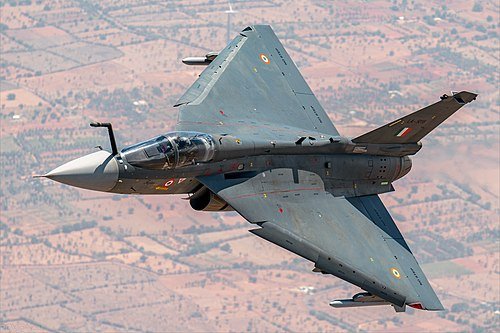
The Ministry of Defence is weighing financial penalties against Hindustan Aeronautics Limited (HAL) after deliveries of the Tejas Mk1A light combat aircraft have slipped by more than two years, according to reports.
The delay in Mk1A production has become a significant concern for the Air Force, which inducted the Tejas Mk1A into operational service in 2023 but has received fewer airframes than planned under the contracted timeline. HAL’s failure to meet contractual milestones has prompted the defence ministry to consider punitive action as a measure to enforce schedule discipline.
The Tejas Mk1A is the production variant of India’s indigenous light combat aircraft programme, developed by the Aeronautical Development Agency under DRDO supervision. The single-engine fighter incorporates design refinements over the Tejas Mk1, including an enlarged air intake, conformal fuel tanks, and enhanced avionics. The aircraft is equipped with an active electronically scanned array radar and can carry air-to-air, air-to-surface, and anti-ship ordnance across multiple hard points.
HAL signed a contract to produce 83 Tejas Mk1A aircraft for the Indian Air Force, with initial deliveries expected to accelerate production rhythm through 2024. The slippage reflects broader challenges in India’s defence production ecosystem, where integration of complex subsystems, supplier coordination, and quality assurance cycles often extend timelines beyond initial projections.
The Mk1A variant was developed to address capability gaps identified during the Mk1’s operational debut. It features upgraded engines, improved cockpit ergonomics, and enhanced combat systems that bring the aircraft closer to regional competitive standards. The Air Force has been clear about its requirement for rapid Tejas availability to plug gaps created by delays in the Medium Combat Aircraft programme and to accelerate retirement of MiG-21 squadrons.
The penalty consideration underscores the ministry’s push to enforce accountability in major defence contracts. Similar pressures have been applied to other platforms experiencing schedule overruns, reflecting a broader policy to make public sector defence manufacturers more responsive to timeline commitments.
HAL has previously attributed production constraints to supply chain management and facility constraints at its Bangalore aerospace complex. The company manufactures Tejas fuselages and integrates major systems at its facility, where capacity and workload management remain recurring challenges across multiple programmes including Dornier transport aircraft and helicopter production lines.
The Tejas programme, which spans over three decades from initial conceptualization to series production, remains India’s flagship indigenous fighter development effort. Accelerating Mk1A delivery is critical to the Air Force’s fleet modernization roadmap, particularly given the timelines required to phase out legacy jet platforms and maintain combat squadron strength during the transition to the Medium Combat Aircraft.
-
-

-

-