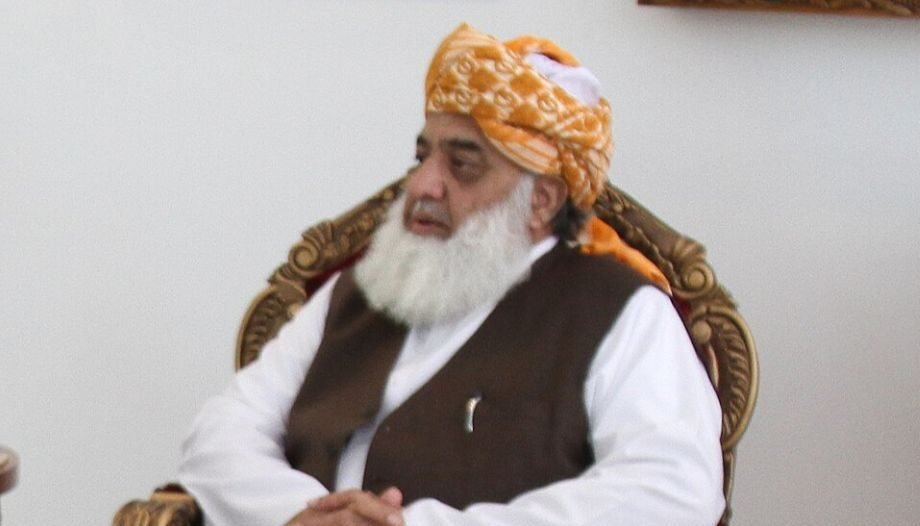
Pakistan’s political tensions have taken another sharp turn after Jamiat Ulema-e-Islam (F) chief Maulana Fazlur Rehman openly criticised the country’s military establishment and invoked the 1971 war with India while addressing a party gathering in Peshawar.
Fazlur Rehman’s remarks appeared aimed at Pakistan Army chief Field Marshal Asim Munir and the military leadership’s public projection of strength. Rather than directly challenging the army’s military capabilities, the JUI-F leader pointed to Pakistan’s own history to argue that strong declarations do not necessarily prevent a political or territorial crisis.
During the convention, Rehman recalled the final phase of the 1971 war, when Pakistan’s military leadership had publicly spoken of continuing the fight shortly before Pakistani forces surrendered in Dhaka. He used that episode as a warning against what he described as excessive confidence from the present-day establishment.
The reference to 1971 is particularly significant because the conflict resulted in the break-up of Pakistan and the emergence of Bangladesh. Pakistani forces surrendered in Dhaka on December 16, 1971, bringing the war to an end after 13 days of fighting. Rehman used the historical episode to question whether today’s claims of strength should be viewed without considering the consequences of past political and military decisions.
His criticism also extended beyond the military leadership. Fazlur Rehman questioned why ordinary Pakistanis continue to face difficulties while the country’s powerful institutions remain focused on political confrontation and control. He argued that prolonged pressure on the population could deepen instability rather than strengthen the state.
The JUI-F chief further warned that sustained violence and what he described as oppression could eventually have consequences for Pakistan’s territorial integrity. His reference to possible “geographical changes” has drawn particular attention because of its connection to the country’s experience in 1971.
Rehman’s comments come amid continuing debate inside Pakistan over the military’s influence in political affairs. His latest intervention puts the 1971 defeat back into the political conversation and uses one of the most sensitive episodes in Pakistan’s history to challenge the establishment’s current approach.
By bringing up the events surrounding the surrender in Dhaka, the JUI-F leader effectively contrasted the confidence expressed by military authorities with the outcome of 1971. His argument was that political leaders and institutions should not underestimate the consequences of prolonged confrontation, particularly when the wider population is already facing hardships.
The remarks are likely to add further pressure to Pakistan’s already complicated civil-military debate. They also demonstrate how the memory of 1971 continues to be used in Pakistan’s domestic political discourse whenever questions arise over military power, governance and the country’s internal stability.
For Pakistan’s military establishment, Fazlur Rehman’s intervention represents another high-profile political criticism. For the JUI-F chief, invoking 1971 appears to be a deliberate reminder that military strength alone cannot guarantee political stability or national unity.
-

-

-

-