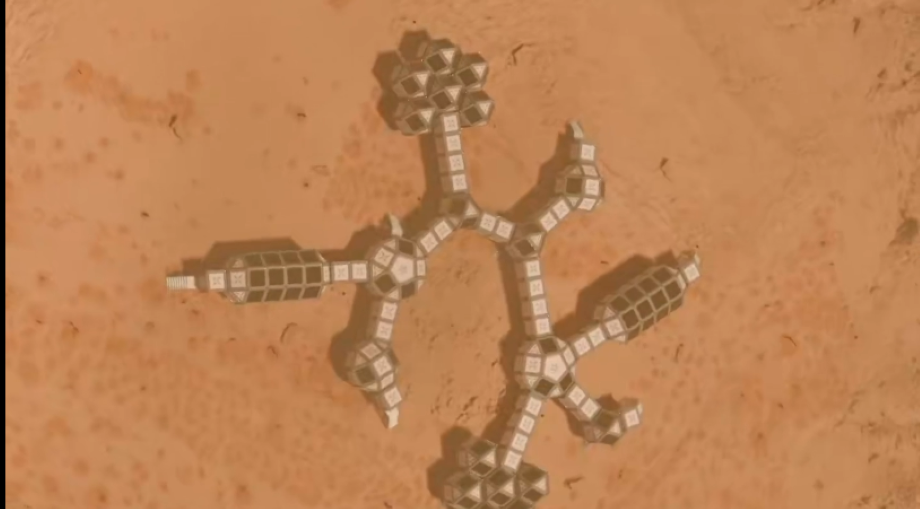
India’s human space exploration ambitions are moving beyond spacecraft and launch systems, with researchers at the Indian Institute of Science (IISc), Bengaluru, developing BHEEM, a modular extraterrestrial habitat concept designed for future human missions to the Moon and Mars.
BHEEM, or Bhartiya Extraterrestrial Expandable Modular Habitat, focuses on one of the biggest challenges of long-duration space exploration: creating safe and spacious living environments for astronauts after they reach another world. The concept was developed by IISc researchers including Mritunjay Baruah, Amogh Jadhav, Bimalendu Mahapatra, Group Captain Shubhanshu Shukla and Professor Aloke Kumar.
The proposed habitat uses a panel-based architecture instead of transporting a large, fully assembled structure. Individual panels could be packed efficiently inside a launch vehicle and assembled after reaching the lunar or Martian surface. This approach could help maximise available payload space while allowing the habitat to be expanded according to mission requirements.
Researchers examined different geometric panel configurations, including triangular, square and pentagonal designs, to assess structural strength and volume efficiency. The resulting concept is intended to provide a flexible architecture that could support astronauts’ living and working activities during extended missions.
The BHEEM design has also been studied in the context of future heavy-lift launch systems such as SpaceX’s Starship. According to the research, a single Starship payload could potentially deploy a BHEEM configuration offering around twice the habitable volume of the International Space Station.
The concept is particularly significant because future lunar and Martian missions will require more than spacecraft capable of reaching their destinations. Astronauts will need habitats capable of providing protection, living space and support for scientific operations in extremely challenging environments.
BHEEM remains a research and design concept rather than a ready-to-deploy space habitat. Further engineering, testing and development would be required before it could be considered for an actual crewed mission. However, the project highlights India’s growing focus on technologies that could eventually support a sustained human presence beyond Earth.
-
-

-

-