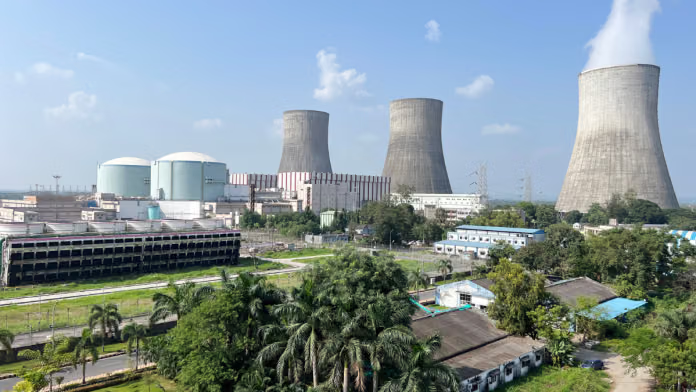
India and Pakistan have maintained an undeclared but consistent mutual understanding not to target each other’s nuclear installations during military conflict, a strategic restraint rooted in both nations’ commitment to preventing catastrophic escalation and their adherence to international nuclear safety protocols.
The bilateral restraint reflects a deeper recognition that nuclear facilities represent a threshold beyond which conventional military competition must not cross. Both nations operate under the assumption that any direct strike on the other’s nuclear weapons production, storage, or command infrastructure would trigger uncontrollable escalation with existential consequences for the subcontinent.
India’s nuclear doctrine, released by the National Security Advisor’s office in 1999 and refined in 2003, explicitly defines credible minimum deterrence as the strategic foundation. The doctrine stipulates no-first-use of nuclear weapons and emphasizes massive retaliation in response to a nuclear attack. Critically, it does not define nuclear weapons facilities themselves as legitimate conventional targets, maintaining the principle that such installations exist in a separate strategic category.
Pakistan’s strategic posture similarly abstains from targeting India’s nuclear infrastructure despite Pakistan’s declared first-use doctrine. This restraint is particularly significant given Pakistan’s numerical disadvantage in conventional capabilities, which theoretically might incentivize preemptive strikes against Indian nuclear assets. That such strikes do not occur reflects a calculated assessment that crossing this threshold would invite immediate and total retaliation without proportionate benefit.
The International Atomic Energy Agency has documented that both nations maintain robust safeguards at their major nuclear installations. India’s three military plutonium production reactors at Bhabha Atomic Research Centre in Mumbai, the reprocessing facilities at Tarapur, and uranium enrichment plants in Hyderabad represent critical nodes in India’s nuclear arsenal. Similarly, Pakistan’s uranium enrichment complex at Kahuta and weapons design facilities at Wah remain among South Asia’s most closely guarded military installations.
Historical precedent strengthens this unwritten understanding. The 1999 Kargil conflict, despite its intensity and proximity to nuclear-armed adversaries, saw no targeting of nuclear facilities by either side. The 2001-2002 military standoff following the Parliament attack in New Delhi similarly maintained this implicit boundary, even as over a million troops mobilized along the border.
Western strategic analysts attribute this restraint partly to the technical difficulty of reliably destroying dispersed or hardened nuclear facilities through conventional means. A failed strike would trigger massive retaliation for minimal damage, making the cost-benefit calculation unfavorable. Additionally, both nations recognize that transparency in nuclear safety builds confidence and reduces the likelihood of accidental escalation.
The mutual non-targeting of nuclear installations effectively operates as a de facto confidence-building measure, one of the few stable elements in an otherwise volatile relationship that has produced four wars and multiple crises since 1947.
-

-

-

-