
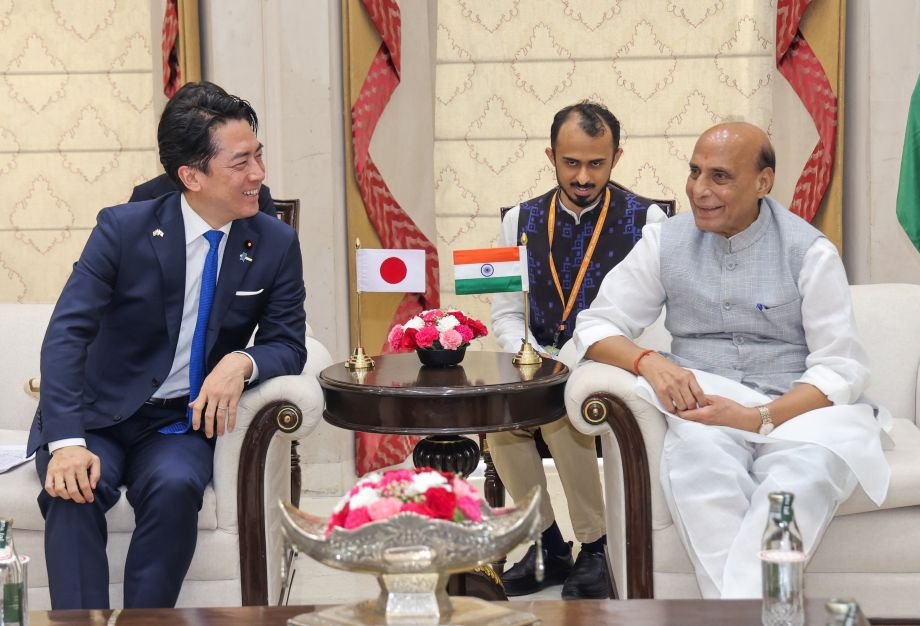
Defence Minister Rajnath Singh and his Japanese counterpart Shinjiro Koizumi signed a Memorandum of Arrangement on Maritime Security Cooperation in New Delhi on Thursday, marking a significant step toward operational and industrial depth in the India-Japan defence partnership.
The accord, signed on August 20, establishes mechanisms for greater information sharing on Maritime Domain Awareness, closer cooperation between the Indian Navy and the Japan Maritime Self-Defence Force, and expanded work in search and rescue and humanitarian assistance and disaster relief operations.
Beyond maritime operations, the two sides agreed to accelerate collaboration in naval shipbuilding, defence technology, logistics, and military exercises. India and Japan committed to strengthening cooperation to protect sea lines of communication through naval visits, joint exercises, personnel exchanges, and logistical support, including access to ports and maintenance and repair facilities.
The most consequential outcome for India lies in industrial cooperation. The two nations agreed to explore joint development in naval shipbuilding and design, combining Japan’s technological expertise with India’s production capabilities. Both sides also committed to deepening discussions on Japan using Indian production capacity under the Make in India framework, and to conclude a ship-repair arrangement in the near future.

The India Navy operates one of the world’s largest naval fleets, with a diverse inventory spanning aircraft carriers, destroyers, frigates, corvettes, and submarines. The service has modernized significantly since the 1990s, adding indigenous platforms such as the INS Vikramaditya (acquired and refitted), INS Kochi-class guided-missile destroyers, and the Kalvari-class diesel-electric submarines. India has been pushing indigenization under the Make in India initiative and has sought technology transfers from advanced maritime powers to build sovereign shipbuilding capability.
Japan’s interest in India as a manufacturing partner reflects Tokyo’s strategic realignment. The Japanese government has pushed its Mogami-class frigate proposal, including technology transfer and local production, for potential sale to India. This latest joint statement provides broader political and industrial context for that proposal, though no final decision has been announced on the frigate programme.
The two Ministers highlighted the shipborne UNICORN integrated communications antenna project as a symbol of the emerging partnership. UNICORN is the first defence equipment transfer project between the two countries. Both sides committed to its early realisation. Singh welcomed Japan’s recent review of its framework for the transfer of defence equipment and technology, expressing expectations for deeper defence and technology cooperation.
The shift toward operational and industrial execution is particularly important against the backdrop of the Quad alliance and the broader strategic imperative of countering Beijing’s maritime assertiveness in the Indian Ocean and Pacific regions. India and Japan share concern over freedom of navigation, sea lane security, and respect for international law in areas of strategic importance.




Facebook Comments