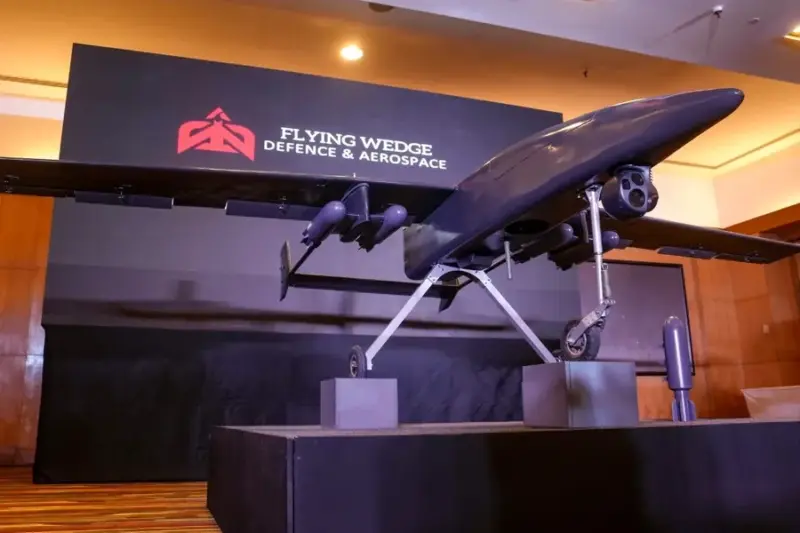
India has developed Kaal Bhairava, an artificial intelligence-enabled long-endurance combat drone designed to extend unmanned aerial operations across extended ranges and mission durations. The system represents a significant step in the country’s indigenous combat drone capability.
Kaal Bhairava is engineered to operate autonomously over prolonged periods, leveraging onboard AI systems to navigate, target, and execute missions with minimal real-time operator intervention. This capability addresses a critical gap in India’s unmanned systems portfolio, where sustained aerial presence has traditionally relied on larger platforms with higher operational costs.
The drone’s development aligns with India’s broader indigenisation agenda under the Defence Acquisition Procedure and the Make in India initiative. Unlike imported systems, indigenous combat drones reduce foreign dependency and create a sustainable technology base within Indian aerospace and defence industry ecosystems.
India operates several unmanned aerial systems across the military spectrum. The Indian Air Force operates the Israeli Heron and Searcher platforms for reconnaissance, while the Lakshyadrone, developed by IIT Bombay, has demonstrated payload-delivery capability. Kaal Bhairava sits in the combat-drone segment, a category that requires both extended loiter time and precision strike capability, previously unavailable in Indian service except through foreign procurement.
The AI integration within Kaal Bhairava enables autonomous target recognition and mission planning without operator guidance, reducing latency in decision-making and increasing operational flexibility in contested environments. This capability is particularly relevant for border surveillance and counter-terrorism operations where rapid response to emerging threats is critical.
India’s unmanned systems development is distributed across multiple stakeholders. The Defence Research and Development Organisation, Hindustan Aeronautics Limited, and private sector players including IIT research centres all contribute to the ecosystem. This distributed model accelerates innovation while building indigenous design and manufacturing competencies.
The long-endurance classification indicates Kaal Bhairava can sustain flight for extended periods, possibly 24 hours or more depending on operational profile and payload configuration. Extended loiter time enables persistent area surveillance and rapid response to emerging tactical situations without requiring mission rotations or basing infrastructure.
The drone’s introduction reflects India’s shift toward asymmetric capability development, where smaller, distributed systems provide operational advantages against larger conventional forces. This doctrine has gained prominence in Indian defence planning following irregular warfare experiences in counterinsurgency operations.
Kaal Bhairava’s operational deployment and detailed specifications will likely be revealed through formal induction announcements or military exercise participation. The system’s integration into Indian Army or Air Force units will signal confidence in indigenous combat drone technology and mark a transition from experimental to operational status.
-

-
-
-