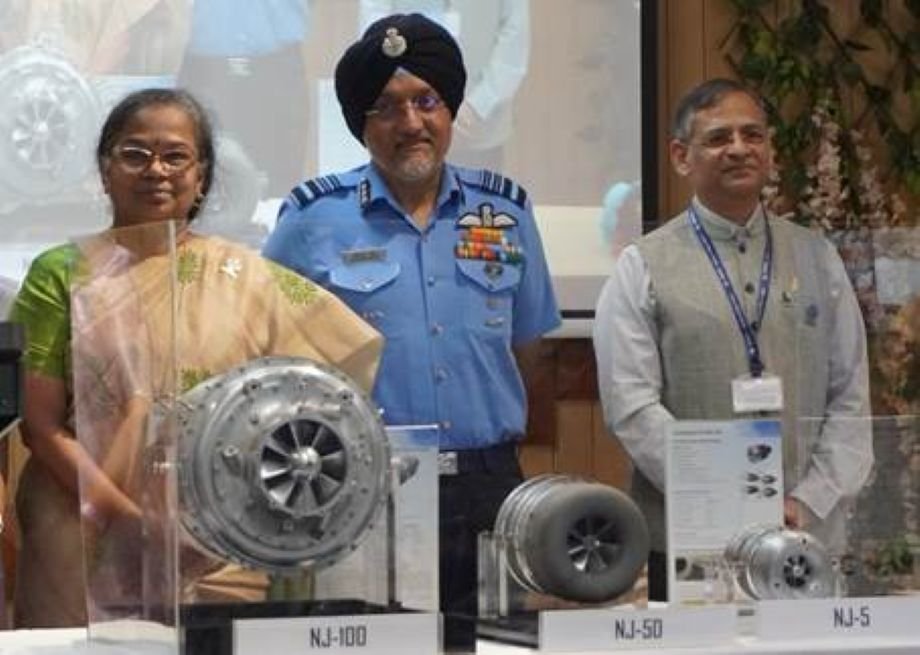
India has strengthened its indigenous aerospace propulsion capabilities with the unveiling of three new gas turbine engines developed by the CSIR-National Aerospace Laboratories (CSIR-NAL). The NJ-05, NJ-50 and NJ-100 engines represent a significant effort to develop compact propulsion technologies for emerging unmanned and defence applications.
The three engines were unveiled at CSIR Headquarters in New Delhi on August 25, 2026, in the presence of senior officials from India’s scientific and defence establishments. The development comes as India places greater emphasis on domestic technologies for unmanned aerial systems and other advanced defence platforms.
The NJ series has been developed across three different thrust categories. The NJ-05 is designed to deliver 5 kg of thrust, the NJ-50 provides 50 kg of thrust, and the NJ-100 produces 100 kg of thrust. This range allows the propulsion family to address different platform requirements, from smaller unmanned systems to more demanding tactical applications.
According to CSIR-NAL, the engines are intended for potential use in tactical unmanned aerial vehicles, drone interceptors and compact missile systems. Their development is particularly relevant as UAVs and autonomous systems become increasingly important in modern military operations.
A major focus of the programme is the development of critical propulsion technologies within India. Gas turbine engines require specialised expertise in areas such as high-speed turbomachinery, combustion, thermal management and precision engineering. Building these capabilities domestically can help strengthen the country’s broader aerospace manufacturing ecosystem.
The NJ-05, NJ-50 and NJ-100 also demonstrate the importance of developing propulsion systems suited to smaller defence platforms. While large aircraft engines require substantial infrastructure and investment, compact gas turbine engines can support a growing range of unmanned platforms where size, weight and power efficiency are critical considerations.
The programme could provide further opportunities for Indian private-sector companies and aerospace start-ups. Once mature propulsion technologies become available for industrial production, domestic manufacturers could potentially integrate them into locally developed UAVs and other defence systems.
The development is also aligned with India’s wider Atmanirbhar Bharat objective of reducing dependence on imported defence technologies. Indigenous propulsion is particularly important because access to reliable engines can directly influence the design, production and operational independence of unmanned platforms.
For India’s expanding drone ecosystem, the availability of domestically developed engines across multiple thrust classes could help create a stronger supply chain and encourage the development of new aerospace applications. It could also enable Indian companies to work with homegrown propulsion technologies while developing platforms for domestic and potential export requirements.
The unveiling of the NJ series marks another step in India’s effort to establish a complete indigenous aerospace technology base. With CSIR-NAL continuing to advance compact gas turbine technology, the NJ-05, NJ-50 and NJ-100 could become important building blocks for future UAVs, drone interception systems and other lightweight defence platforms.
-

-

-

-