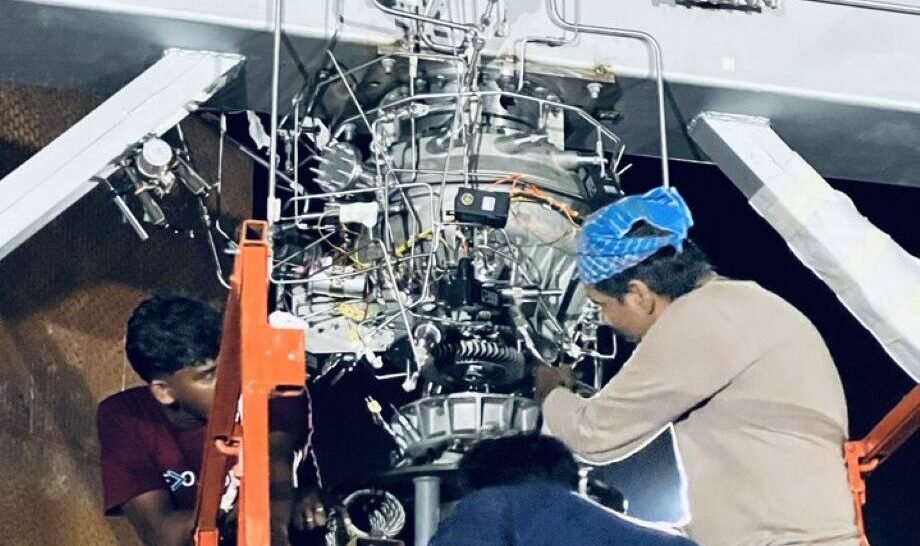
Astrobase Space Technologies is set to unveil India’s first indigenous 80-tonne Full-Flow Staged Combustion (FFSC) methalox rocket engine on August 8, marking a major milestone in India’s commercial space propulsion capabilities. The engine, which produces approximately 800 kilonewatts of thrust, represents a leap into one of the world’s most technically demanding propulsion technologies.
The engine is being developed under the Technology Adoption Fund (TAF) scheme administered by IN-SPACe, India’s National Space Promotion and Authorisation Centre. This funding mechanism accelerates the development of critical space technologies by private companies aligned with India’s self-reliance objectives in the space sector.
Full-flow staged combustion engines employ a sophisticated power cycle where both oxidizer-rich and fuel-rich preburners ensure complete gasification of propellants before they enter the main combustion chamber. This design yields higher efficiency and specific impulse compared to simpler engine architectures, making FFSC engines the choice for heavy-lift and super-heavy-lift launch vehicles globally.
The significance of Astrobase’s achievement lies in the engineering complexity. As of 2026, only a handful of FFSC engines have been tested worldwide: SpaceX’s Raptor (the only one to achieve flight), China’s YF-215 (tested in 2023), LandSpace’s BF-20 (tested in 2025), and Stoke Space’s Zenith (2024). India’s entry into this select group underscores the nation’s trajectory toward indigenous heavy-lift launch capability and reduces dependence on foreign propulsion systems.
Astrobase has been conducting hot-fire testing at its propulsion test facility to validate the engine’s performance under operating conditions. Such testing confirms the integrity of the combustion chamber, turbopumps, preburners, and feed systems under extreme temperature and pressure. The August 8 unveiling signals readiness to transition from development to pre-qualification phases.
This engine aligns with India’s broader strategy to develop its own launch vehicles beyond ISRO’s current offerings. The 800 kN thrust class positions the Astrobase engine as suitable for first-stage propulsion in medium-lift and upper-stage duty in heavier systems. India’s emerging private launch sector, exemplified by Skyroot Aerospace’s recent success with Vikram-1, demonstrates the ecosystem’s growing capability to field multiple independent launch options.
The unveiling also reflects the pace of technology diffusion in India’s defence and space ecosystem. While ISRO’s cryogenic engines (CE-20) and semi-cryogenic engines (SE-2000) serve government launch vehicles, private industry’s participation through IN-SPACe mechanisms accelerates innovation cycles and reduces time-to-operationalisation for next-generation propulsion systems.
-

-

-

-