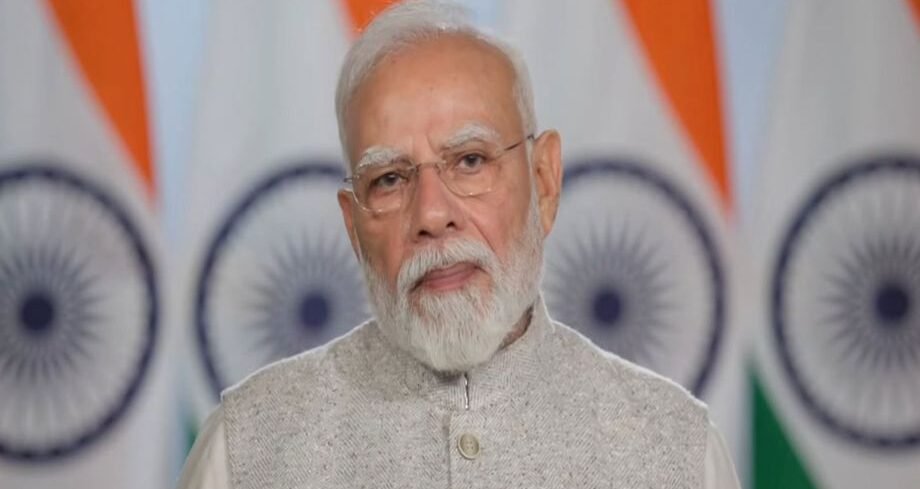
India has achieved another important milestone in its space programme with the successful launch of the NVS-03 navigation satellite. Prime Minister Narendra Modi congratulated scientists and engineers of the Indian Space Research Organisation (ISRO), highlighting the mission’s role in strengthening India’s indigenous Navigation with Indian Constellation (NavIC) system. The achievement marks further progress in developing independent satellite navigation capabilities for civilian and strategic requirements.
The satellite was launched on October 30, 2026, at 11:51 PM IST aboard the GSLV-F18 rocket from the Satish Dhawan Space Centre in Sriharikota, Andhra Pradesh. The launch vehicle successfully injected NVS-03 into its designated Geosynchronous Transfer Orbit (GTO). The mission marked the 20th flight of India’s Geosynchronous Satellite Launch Vehicle and demonstrated ISRO’s continued progress in conducting complex space missions.
On October 31, Prime Minister Narendra Modi congratulated the ISRO team through a message shared on social media. He described the launch as an important development for India’s indigenous navigation infrastructure. The Prime Minister also highlighted the satellite’s enhanced capabilities, stating that it would support the country’s efforts towards self-reliance in critical technologies and improve navigation services for citizens.
Union Minister of State for Science and Technology Dr Jitendra Singh also congratulated ISRO following the successful mission. He highlighted India’s growing strength in space technology and its commitment to developing sovereign navigation capabilities. He further acknowledged the contribution of India’s pioneering space scientists, including Vikram Sarabhai and Satish Dhawan, whose vision helped establish the country’s space programme.

One of the most significant outcomes of the NVS-03 mission is the restoration of NavIC to its minimum operational configuration of four satellites. ISRO Chairman V. Narayanan highlighted this development after the launch, explaining that the additional satellite would strengthen the availability of India’s independent positioning and navigation services.
NVS-03 is the third spacecraft in India’s second-generation NVS satellite series, which consists of five planned satellites. It carries navigation payloads operating in the L1, L5 and S frequency bands. The inclusion of the L1 signal is an important upgrade because it can improve compatibility with a wider range of civilian navigation receivers and support the expansion of NavIC-based applications.
The satellite also carries an indigenously developed atomic clock alongside procured atomic clocks. These highly precise timing instruments are essential for satellite navigation because positioning systems calculate locations using the time taken by signals to travel between satellites and receivers on Earth. The development of indigenous timing technology is another step towards reducing dependence on foreign equipment for critical space infrastructure.
NavIC is India’s regional satellite navigation system, designed to provide coverage across the Indian landmass and an area extending approximately 1,500 kilometres beyond the country’s geopolitical boundary. Its services include the Standard Positioning Service for civilian users and the Restricted Service for authorised strategic users.
ISRO Chairman V. Narayanan has also highlighted NavIC’s importance as a strategic national asset and its contribution to India’s One Nation, One Time initiative. The system has applications in real-time tracking of trains, road vehicles and shipping vessels, along with transportation, maritime operations, disaster management and other location-based services.
Following the launch, ISRO completed NVS-03’s first orbit-raising manoeuvre on October 31, 2026, at 4:48 PM IST using its Liquid Apogee Motor (LAM). The spacecraft was reported to be in normal health after the operation. According to ISRO, further orbital manoeuvres are planned to place the satellite in its designated geosynchronous orbital slot at 111.75 degrees East.
The mission also set a notable operational milestone for ISRO. The interval between the NVS-03 launch and the previous GSLV mission was 56 days, marking the shortest gap between two successive GSLV flights, as highlighted by the ISRO Chairman.
With NVS-03 successfully placed in its initial transfer orbit, India has taken another step towards strengthening its independent navigation infrastructure. The remaining satellites, NVS-04 and NVS-05, are part of the broader second-generation programme aimed at improving NavIC’s continuity, reliability and coverage. The latest achievement reinforces India’s growing capabilities in space technology and its commitment to technological self-reliance.




Facebook Comments