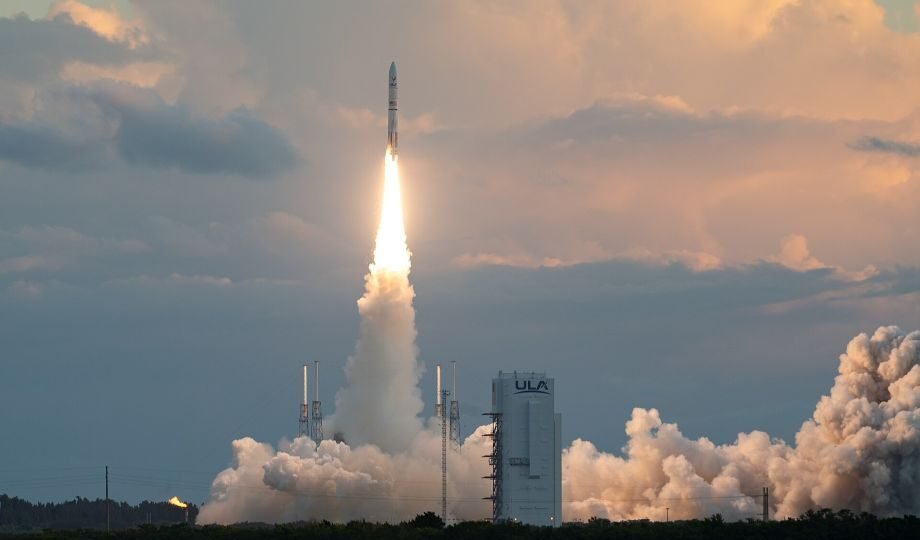
United Launch Alliance (ULA) has experienced a significant setback after its Vulcan rocket failed to complete a satellite deployment mission on November 15, 2026. The launch vehicle was carrying 40 Amazon Leo broadband satellites, all of which were lost after an anomaly occurred approximately 10 minutes into the flight.
The rocket lifted off at 12:40 p.m. Eastern Standard Time from Space Launch Complex 41 at Cape Canaveral Space Force Station in Florida. The mission, designated Vulcan Leo 1, was intended to deliver a new group of satellites into low Earth orbit (LEO), supporting Amazon’s efforts to develop a global satellite internet network.
Initially, the launch appeared to proceed as planned. Vulcan’s six solid rocket boosters separated during the early stages of flight, allowing the vehicle’s main engines to continue powering its journey. However, the mission encountered a serious problem later in the ascent, preventing the spacecraft from reaching their intended orbit.
ULA confirmed the incident in a statement, reporting that its launch director had identified an anomaly around 10 minutes after liftoff. The company acknowledged that the rocket had failed to deliver the Amazon payload into orbit. It also stated that further analysis of flight data would be necessary to establish what had happened.
The failure is particularly important for ULA because it represents the first complete mission loss in the company’s history since its formation in 2006. Established as a joint venture between Boeing and Lockheed Martin, ULA operates launch vehicles supporting commercial customers, government agencies and US national security missions.
This was the fifth flight of the Vulcan rocket since its introduction in 2024 and its first launch in approximately nine months. The vehicle had previously experienced solid rocket booster nozzle problems during two earlier missions. Although those flights successfully delivered their payloads, the incidents resulted in additional technical reviews and corrective work before Vulcan returned to service.
The solid boosters appeared to perform normally during the November 15 launch. However, available flight observations raised questions about the timing of the first-stage burn, stage separation and the subsequent operation of the Centaur upper stage. The exact failure mechanism has not been officially established, and investigators must examine the telemetry before identifying the responsible component.
The incident also affects Amazon’s plans to expand its Leo satellite constellation. Formerly known as Project Kuiper, the programme is designed to deploy more than 3,200 satellites to provide broadband connectivity and compete with SpaceX’s Starlink network. Before the failed mission, approximately 398 Amazon Leo satellites had been deployed, according to Reuters.
Amazon had secured 38 Vulcan launches from ULA to support the constellation’s expansion. Losing 40 additional satellites and facing uncertainty over Vulcan’s return to flight could complicate the company’s deployment schedule.
Blue Origin, which manufactures the BE-4 engines powering Vulcan’s first stage, is also involved in supporting the investigation. However, no confirmed evidence has established that the engines caused this particular failure.
For ULA, the immediate priority will be identifying the technical problem, implementing necessary corrections and demonstrating that Vulcan can safely return to operations. The investigation’s findings will be important for both commercial satellite launches and future US government missions.