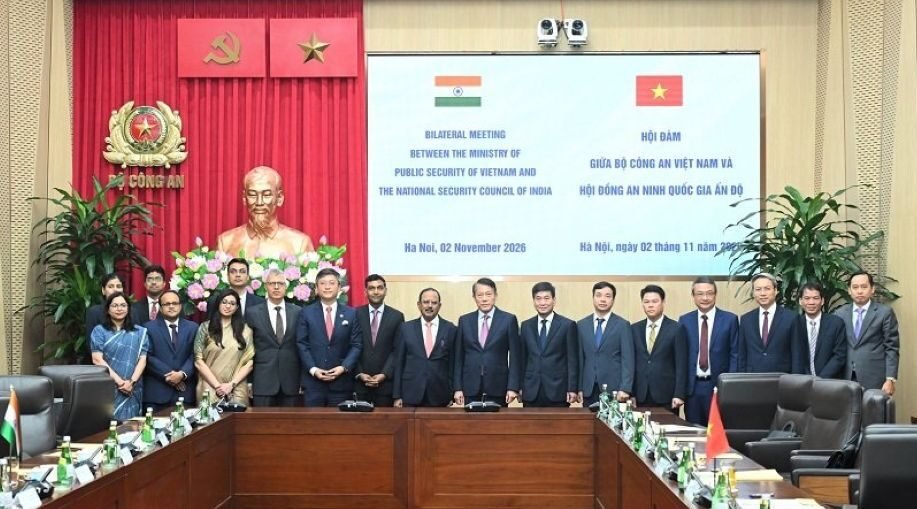
Vietnam is seeking to deepen its intelligence and security cooperation with India as China’s growing maritime influence continues to raise concerns across the Indo-Pacific region. The proposal emerged during National Security Adviser (NSA) Ajit Doval’s visit to Hanoi, where discussions with senior Vietnamese officials focused on real-time intelligence sharing, cybersecurity, classified information and expanding defence ties.
Doval arrived in Vietnam on November 1 and held meetings on November 2 with Deputy Prime Minister and Defence Minister General Phan Van Giang and Public Security Minister General Luong Tam Quang. The discussions highlighted the growing importance of India-Vietnam relations amid changing regional security conditions and increasing geopolitical competition.
One of the key developments was Vietnam’s proposal to strengthen the exchange of strategic intelligence with India. Both sides discussed improving mechanisms for sharing information on political developments, regional security conditions, emerging threats and international affairs. Hanoi also emphasised the need for faster and more reliable communication channels between the senior leadership of both countries to improve coordination on security-related matters.
Vietnam additionally expressed interest in developing an agreement covering the mutual protection and exchange of classified information. General Luong Tam Quang urged India’s National Security Council Secretariat to coordinate with relevant Indian agencies to advance discussions on the proposed arrangement. The framework could provide greater confidence between the two countries and facilitate cooperation involving sensitive security information. However, no new intelligence-sharing treaty was announced as signed during the visit.
Cybersecurity and emerging technologies were also important areas of discussion. Vietnam sought India’s support in artificial intelligence, digital transformation, cybersecurity incident response and specialised training. The two countries have already conducted a Cyber Policy Dialogue in January 2026 and their first Cybersecurity Consultation in September. Their fourth Deputy Minister-level Security Dialogue, held in New Delhi on October 16, also covered maritime security, counterterrorism, economic security and emerging technologies.
Defence cooperation remains a major pillar of the bilateral relationship. During his meeting with General Phan Van Giang, Doval reviewed ongoing defence engagement and discussed opportunities to expand collaboration. Vietnam also invited Indian defence companies to participate in the Vietnam International Defence Expo scheduled for December 2026.
India has strengthened Vietnam’s military and maritime capabilities through several defence initiatives. In July 2023, New Delhi gifted the missile corvette INS Kirpan to the Vietnamese Navy and supplied 12 high-speed guard boats under a $100 million defence credit facility. India has also confirmed an agreement to supply BrahMos supersonic cruise missiles to Vietnam, marking another significant development in bilateral defence relations.
China’s expanding maritime presence and its longstanding territorial disputes with Vietnam in the South China Sea provide an important strategic backdrop to the growing partnership. The region is a major international shipping corridor and remains a sensitive area of geopolitical competition.
For Vietnam, stronger cooperation with India offers opportunities to diversify its security partnerships, improve defence capabilities and strengthen its ability to address emerging threats. For New Delhi, closer relations with Hanoi support its Act East Policy and broader vision of a free, open and stable Indo-Pacific.
Although neither government has publicly confirmed that China was specifically discussed during Doval’s meetings, the latest developments indicate that India-Vietnam relations are expanding beyond conventional defence cooperation into intelligence sharing, cybersecurity and strategic security coordination.
-
-
-
-