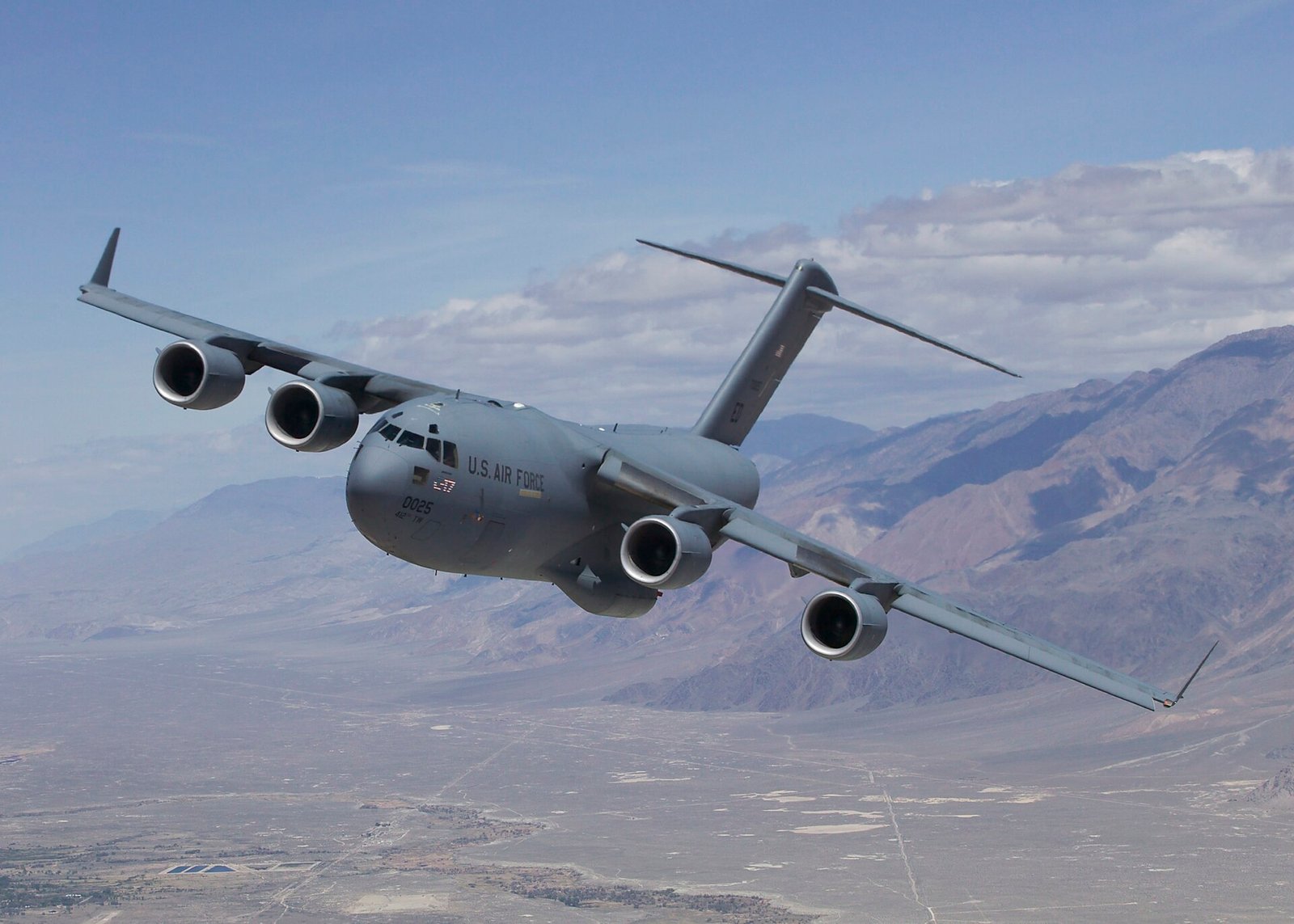
The United States is weighing a restart of C-17 Globemaster III production, a development that could reshape India’s heavy-lift transport architecture and signal renewed availability of one of the world’s most capable military cargo aircraft.
India currently operates a fleet of ten C-17 Globemasters, acquired between 2009 and 2014 as the backbone of the Indian Air Force’s strategic airlift capability. These aircraft have proven indispensable for national disaster relief, humanitarian missions, and expeditionary operations across the Indian Ocean region and beyond.
The C-17 is capable of carrying 77,500 kg of payload across intercontinental distances without refuelling. It can operate from austere airfields with limited infrastructure, a critical advantage for India’s deployment flexibility across diverse terrain from the Northeast to island territories and forward operating bases along contested borders.
Since Boeing completed the original C-17 production line in 2015 after delivering 223 aircraft to global operators, India has faced the prospect of managing its current fleet without access to fresh airframes. A restart would open the possibility of expanding India’s strategic airlift capacity at a time when military modernisation and disaster response demands are rising.
India’s defence acquisition strategy has increasingly emphasised reducing dependency on ageing legacy platforms. The Air Force’s transport fleet also includes the Lockheed Martin C-130J Super Hercules and the indigenously developed Hindustan Transport Aircraft (HAT), which is under development by HAL as a medium-lift regional cargo platform. However, neither of these matches the C-17’s heavy-lift and range characteristics.
From a strategic perspective, C-17 production restart aligns with the broader US-India defence partnership, particularly the deepening of military interoperability through the QUAD framework and enhanced US-India bilateral defence ties. India’s participation in joint exercises, logistics agreements, and platform standardisation continues to reinforce the role of American military platforms in Indian operations.
A restart would also carry cost implications. C-17 unit prices have historically ranged between $300-400 million depending on configuration and procurement batch. India would need to justify additional heavy-lift acquisitions against competing modernisation priorities, including fighter jets, helicopters, and indigenous transport aircraft development.
The question of production restart also hinges on US defence budgetary priorities and congressional support. Any new production run would require formal procurement decisions from India’s Ministry of Defence and Air Force leadership, assessments that remain tied to broader defence spending constraints and the trajectory of the HAT programme.
-

-
-

-