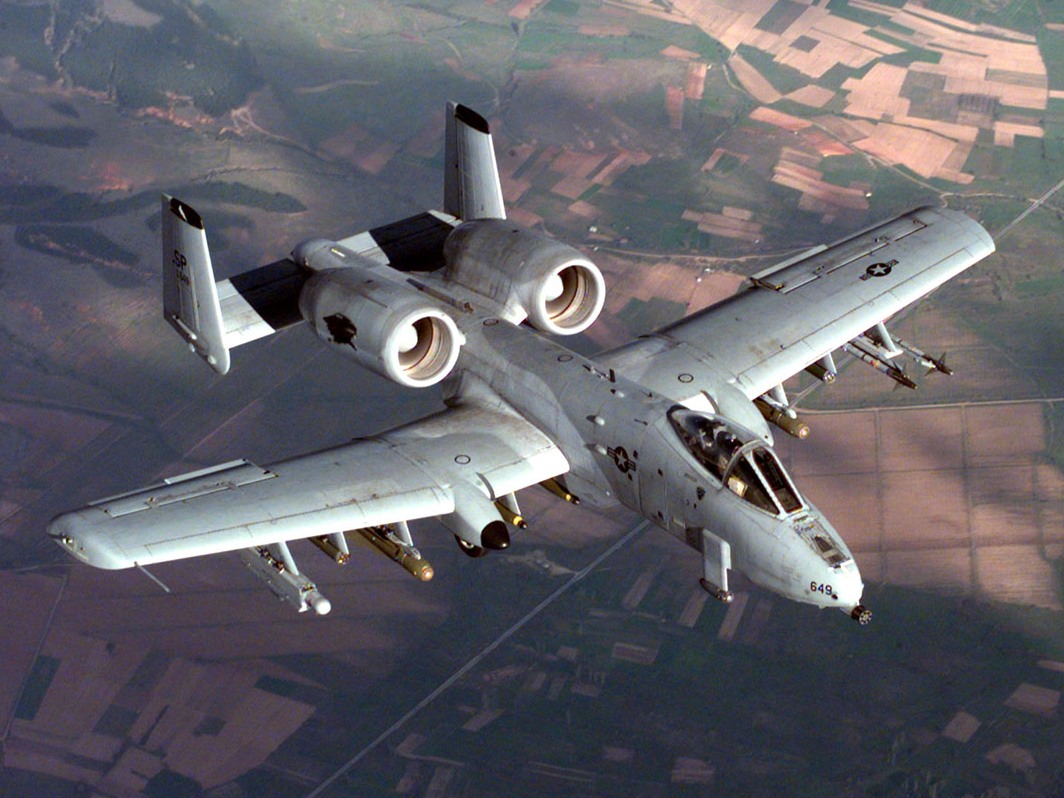
The United States has deployed A-10 Thunderbolt II attack aircraft across the Middle East as American military forces maintain an extended operational presence in the region, according to recent reports.
The A-10, commonly known as the Warthog, remains one of the world’s most formidable close air support platforms. The twin-engine jet is purpose-built for low-altitude warfare and precision strikes against ground targets, making it a cornerstone of US Air Force doctrine in contested theatres.
Equipped with the GAU-8 Avenger rotary cannon, one of the most powerful aircraft-mounted guns in existence, the A-10 fires 30mm depleted uranium rounds at a rate of up to 3,900 rounds per minute. This capability allows the platform to deliver devastating firepower against armoured vehicles, fortified positions, and static targets with minimal collateral risk.
The aircraft can carry up to 16,000 pounds of external ordnance, including Maverick missiles, laser-guided bombs, and cluster munitions. Its design prioritises survivability in high-threat environments, featuring redundant hydraulic systems, cockpit armour protection, and an airframe engineered to withstand direct hits from anti-aircraft artillery.
The A-10’s deployment across the Middle East underscores the US military’s commitment to maintaining combat-ready air superiority and rapid-response capabilities in a region marked by persistent security challenges. The aircraft’s loiter time, which exceeds three hours without refuelling, makes it ideal for sustained close air support missions alongside ground operations.
From an Indian defence perspective, the A-10’s operational model offers instructive lessons for air power integration with ground forces. The Indian Air Force has invested heavily in indigenous and foreign close air support systems, including the HAL Tejas Light Combat Aircraft, which is being developed with both air-to-air and ground-attack configurations. The Tejas Mk1A variant incorporates air-to-ground targeting pods and precision-guided munition compatibility.
India’s acquisition of the Apache AH-64 attack helicopter from the United States similarly reflects New Delhi’s focus on attack platform modernisation for counter-insurgency and conventional warfare scenarios. These platforms complement India’s existing gunship fleet and fill critical gaps in close air support doctrine.
The sustained US military posture in the Middle East also reflects broader geopolitical recalibration, with implications for Indo-Pacific security architecture and India’s strategic partnerships. As the US maintains forward-deployed assets across multiple theatres, India continues strengthening its own defence industrial base and operational readiness across air, land, and maritime domains.
-
-

-
-