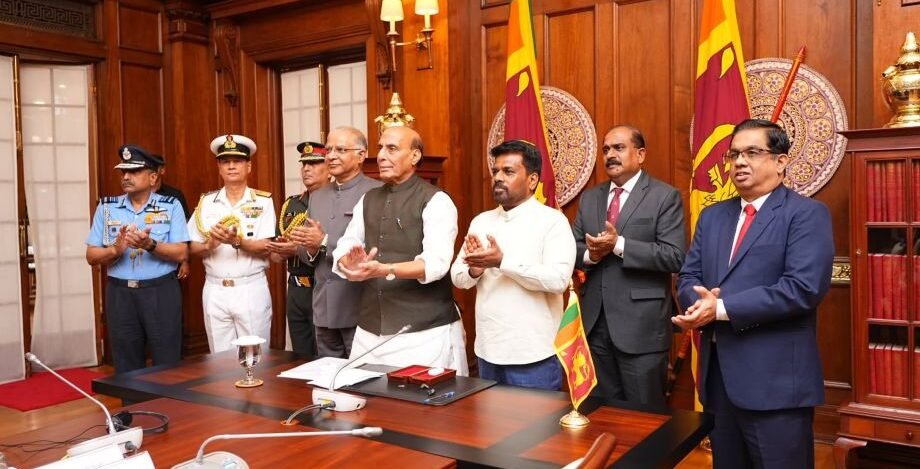
India and Sri Lanka have reaffirmed their commitment to strengthening bilateral cooperation in defence, maritime security, economic development and regional stability following a high-level meeting between Defence Minister Rajnath Singh and Sri Lankan President Anura Kumara Dissanayake in Colombo on September 9, 2026.
Rajnath Singh, who is on a three-day official visit to Sri Lanka, held discussions with President Dissanayake covering the broad spectrum of the India-Sri Lanka partnership. The meeting focused on the longstanding relationship between the two countries and their shared interest in promoting development, security, peace and prosperity in the region.
The discussions come as India and Sri Lanka continue to strengthen their strategic partnership in the Indian Ocean Region. Both countries share close civilisational ties and have increasingly focused on cooperation in maritime security, defence capacity building and regional stability. During the meeting, Sri Lankan President Dissanayake reiterated that Sri Lanka would not allow its territory to be used for activities that could be detrimental to India’s security interests.
Defence cooperation also featured prominently during Singh’s Colombo engagements. India and Sri Lanka signed agreements covering the upgradation of six L70 air-defence guns of the Sri Lanka Air Force through an Indian government grant. The two sides also signed agreements to strengthen cooperation between the National Cadet Corps of India and Sri Lanka and between the National Defence Colleges of the two countries.
The L70 gun upgrade initiative is aimed at enhancing the operational capability of Sri Lanka’s air-defence assets. The cooperation involving the National Cadet Corps is expected to formalise youth exchanges, while the National Defence College agreement will support greater institutional and professional interaction between the two countries’ defence establishments.
Maritime security remains another important pillar of the growing partnership. Addressing senior Sri Lankan defence officials in Colombo, Singh stressed that secure sea lanes, freedom of navigation, respect for international law and uninterrupted maritime trade are essential for the collective security and prosperity of the Indian Ocean Region. He called for greater India-Sri Lanka cooperation to address emerging maritime challenges before they develop into more serious security threats.
The two countries already cooperate in areas including search and rescue, counter-narcotics, anti-piracy and maritime security. Singh also highlighted the importance of mechanisms such as the Colombo Security Conclave and the Maritime Rescue Coordination Centre in strengthening coordination across the region. India and Sri Lanka are also looking at deeper cooperation in Maritime Domain Awareness and humanitarian assistance and disaster relief.
Beyond defence and security, Singh’s Colombo engagements also highlighted India’s economic transformation and expanding defence-industrial capabilities. Addressing the Indian community in Sri Lanka, he highlighted the growth of India’s defence exports, which have reached a record level of around ₹39,000 crore, compared with approximately ₹600 crore 12 years ago. He also pointed to the expansion of India’s defence budget and the country’s continuing efforts towards greater self-reliance in defence production.
The visit comes under India’s broader Neighbourhood First policy and the MAHASAGAR vision, with New Delhi seeking to deepen partnerships with countries across the Indian Ocean. India has also continued to provide assistance to Sri Lanka during times of crisis, including support following Cyclone Ditwah in 2025.
Rajnath Singh’s Colombo visit therefore marks another important step in strengthening India-Sri Lanka relations, particularly in defence and maritime security. With both nations sharing strategic interests in the Indian Ocean, the latest talks are expected to provide further momentum to bilateral defence cooperation, capacity building and regional security.
-

-

-

-